
As Embodied AI Crosses the Mass-Production Threshold, Dev and Education Platforms Take Up Deployment
Humanoid and quadruped robots are moving from demo videos to production lines, and 2026 is read by many analysts as the mass-production inflection point for embodied AI. Yet before a robot can do stable real work, it still has to clear hurdles in data, models, the body itself and real applications. Ahead of that, universities, research teams and integrators spend much of their time validating motion control, collecting training data and tuning visual perception on desktop-scale platforms. For the supply chain, what gets pulled along first is often not the mass-produced robot, but open-development robot platforms, robotic arms and depth-vision modules.
Below the mass-production threshold, the bottleneck is still task capability
According to China Securities Journal, UBTech's 10,000-unit industrial humanoid plant in Liuzhou came online in September 2026, EngineAI's Shenzhen base supports 10,000-unit delivery capacity, and AgiBot has rolled off about 20,000 embodied robots across multiple bases. Unitree's STAR Market fundraising is directed at a manufacturing base planned for annual humanoid and quadruped capacity. Both GGII and TrendForce point to tens of thousands of global whole-unit shipments in 2026, more than doubling year on year, with Chinese makers accounting for the large majority of global output.
Added capacity does not mean a mature industry. The common view is that robots still have to cross four barriers: data, models, the body and applications. Among core components, servo motors, harmonic reducers and structural parts are already well localized; six-axis force-torque sensors and planetary roller screws are in the validation and ramp-up window, while high-end compute chips remain a hard bottleneck. Competition has shifted from athletic stunts to real task capability. Assembly margins keep compressing, and value concentrates more in models, key components and scenario data.
What hardware base the development stage needs
Before a design reaches production, teams usually close the loop on a small platform first: a biped or quadruped validates gait and balance, a six-axis arm validates grasping and imitation learning, and a stereo depth camera supplies spatial perception and target localization. These platforms do not target industrial payload or ingress rating; they prioritize open interfaces, friendly secondary development, replaceable algorithms, and the ability to co-tune vision modules from perception to motion. Selection should start from the purpose: teaching demos, research projects, or a prototype for a later product call for different degrees of freedom, payload and vision accuracy.
| Hardware type | Main role | What to check |
|---|---|---|
| Biped / quadruped body | Gait balance, motion control and mobility validation | Degrees of freedom, expandability, algorithm interfaces, learning materials |
| Six-axis arm | Desktop grasping, imitation learning and teleoperation data capture | Reach and payload, repeatability, host communication |
| Stereo depth module | Close-range positioning, arm vision guidance, spatial perception | Depth range, frame rate, interface and SDK support |
Supply support and deployment judgment
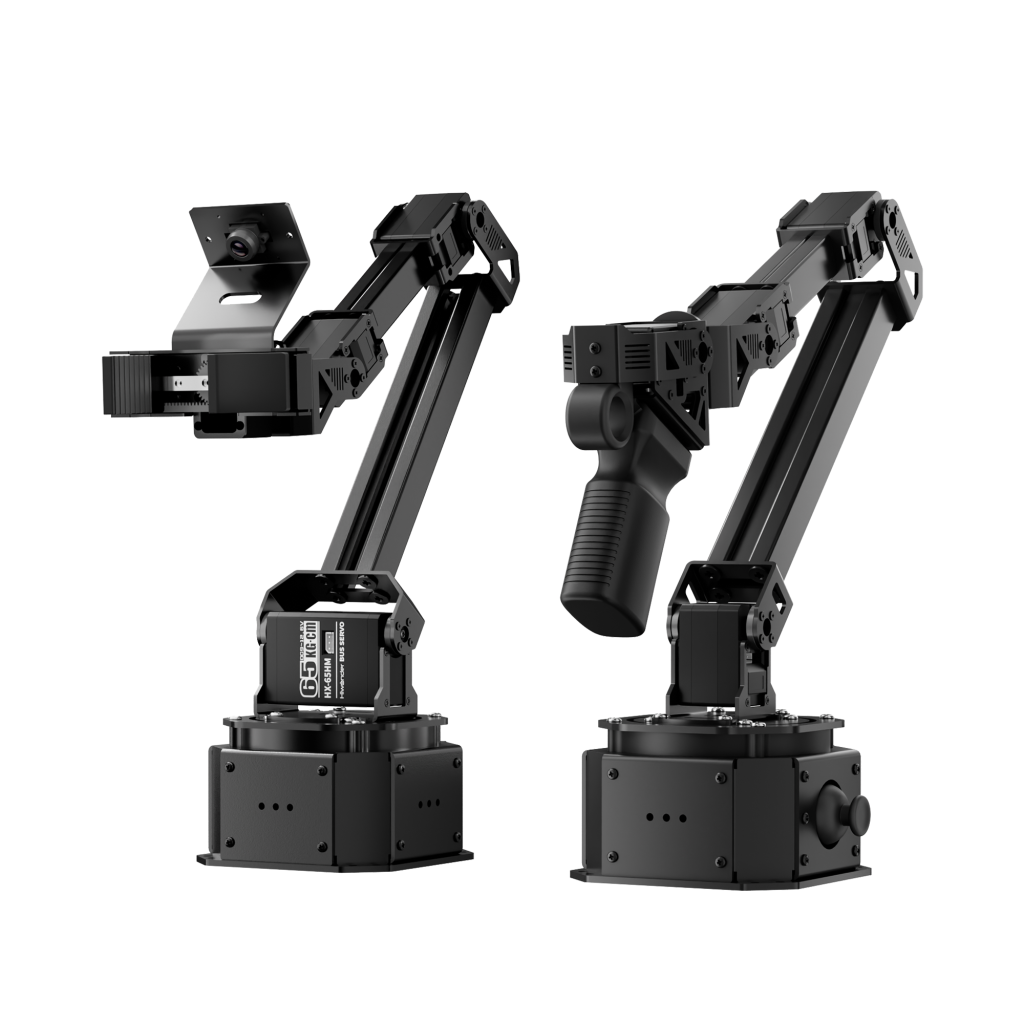
On the open-development hardware side, the body platform, arm and depth vision are usually selected as a set. For robotics teaching and research platforms, Hiwonder supplies whole units aimed at STEAM education, robotics clubs and lab development: the TonyPi Biped Vision Education Robot validates biped gait and visual interaction, the PuppyPi Quadruped Vision Robot targets quadruped motion, visual tracking and mobile robot development, and the NexArm Six-Axis Imitation Learning Arm handles desktop grasping, teleoperation and imitation-learning data capture. On the perception side, HairayVision offers the G62 Compact Stereo Depth Camera for close-range positioning, arm vision and small interactive terminals, and the G100+ HD Stereo Depth Camera for collaborative-arm grasping, warehouse mobile-robot spatial awareness and volume measurement.
For buyers and solution teams, the pragmatic read at this stage is that the embodied-AI opportunity lands first in R&D, teaching and prototyping, where platform hardware serves as a base for algorithm iteration and data accumulation. Real industrial batch deployment still waits for force control, screws, reliability and scenario process to mature. When choosing a platform, there is no need to benchmark mass-production specs; the priorities are open interfaces, community and documentation support, and whether vision and body can be co-developed in one environment.
Comments
No comments yet. Be the first to comment.