
Edge AI Reaches the Factory Floor: Pairing SOMs, Gateways and Industrial Panels
Machine vision, defect inspection, equipment patrol and personnel safety recognition are increasingly handled at the edge, close to the equipment. Where the field network is unstable, raw video should not leave the site, and real-time response matters, relying on cloud inference alone often falls short. Pushing compute down onto a system-on-module, edge gateway or industrial panel to run capture, recognition and linkage locally, and send only alerts back to the platform, is becoming a common architecture for industrial terminals. When selecting, solution teams now look beyond "can it run a model" to hard metrics: compute headroom, wide-temperature tolerance, field interfaces and offline operation.
Why inference moves down to the field
The traditional approach sends device data to a server or cloud first, then stores and analyzes it, which suits reporting and long-term management. But for real-time multi-channel video analysis, defect judgment, perimeter intrusion detection and equipment linkage, the cloud runs into latency fluctuation, network outages and data privacy. Edge computing places part of the compute near the device: after cameras feed in, the stream is decoded and frames extracted locally, an NPU runs detection, classification, OCR or segmentation, and only the judgment result goes back to the backend. In grid patrol, for example, defect recognition, meter reading and boundary-crossing detection are already mature on edge boxes; when the network drops, local analysis continues and only structured alerts are transmitted.
Layered selection: SOM, edge box and industrial panel
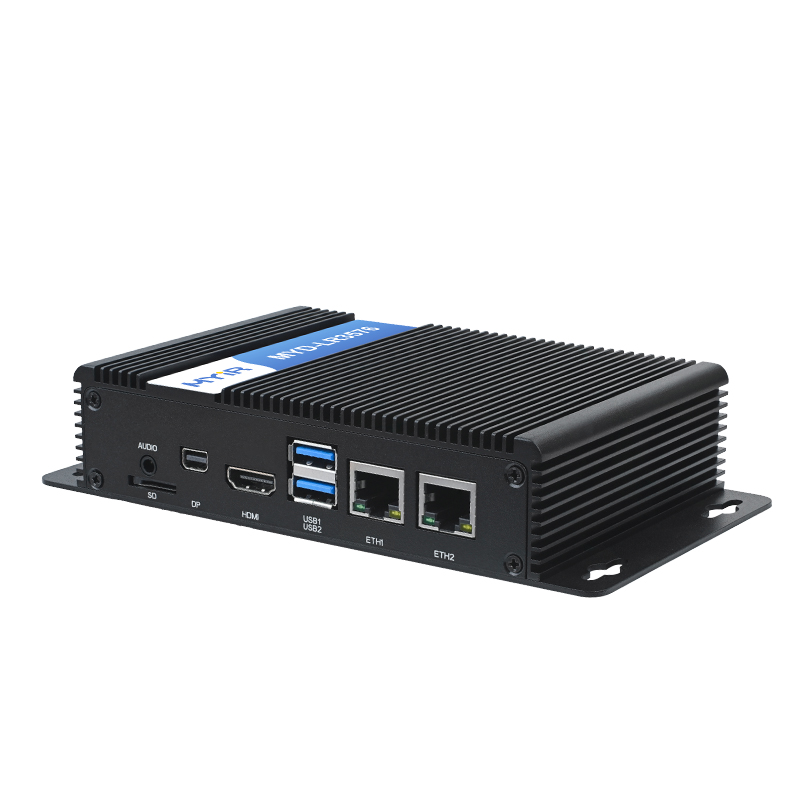
Edge AI hardware usually splits into three forms by project shape. A system-on-module (SOM) targets product development that needs a custom carrier board and enclosure, integrating main control, memory, storage and NPU so engineers can design their own base board around it. An edge computing box or gateway targets fast deployment, integrating isolated power, multiple Ethernet ports, serial ports, CAN and GPIO into a whole unit that comes online once cameras and sensors are connected. An industrial panel combines compute, display and touch as a fixed-station HMI. The three are not mutually exclusive; the common path is to validate on a SOM first, then move to a whole-unit gateway or panel terminal.
| Form | Typical stage | What to check |
|---|---|---|
| SOM | In-house product, custom carrier and structure | Main control and NPU compute, memory/storage expansion, board interfaces |
| Edge box / gateway | Fast field deployment, multi-device connection | Wide-temperature power, Ethernet/serial/CAN, protocol support, remote O&M |
| Industrial panel | Fixed-station HMI, monitoring and operation | Touch display size, mounting method, field environment rating |
Hard metrics for buyers and solution teams
Start by matching NPU compute to the target model: whether a quantized model runs in real time locally matters more than the headline core count of the main control. Next is industrial environmental fit — operating temperature range, supply voltage range, isolation and vibration resistance decide whether the device can stay long term in a cabinet, production line or outdoor station. Third are field interfaces and protocols: enough Ethernet, serial, CAN and GPIO, and the ability to connect to existing PLCs and instruments. On the software side, Linux, Docker and remote model updates affect later maintenance cost. Finally, offline availability: whether local recognition and alarms keep running during a short network outage.
Supply-side reference
On the edge AI hardware side, the forms can be combined by development stage. For SOM and edge boxes, MYIR Electronics offers the MYC-LR3576 Edge AI System-on-Module for industrial terminals, edge AI gateways and multi-screen prototypes, the MYD-LR3576-B Industrial Edge Computing Box for industrial edge applications, AIoT gateways and on-site multimedia trials, and the MYC-YT153MX Real-Time Industrial Control Module for PLCs, industrial gateways, industrial displays and multi-bus data acquisition. On the whole-unit gateway and panel side, METO offers the M88 RK3588 Industrial System-on-Module for industrial HMI, multimedia terminals and edge AI devices, the AI3399Pro Industrial Edge AI Gateway for equipment networking, meter acquisition, building control and light vision inference, and the MT-P8A 8-inch Wall-Mount Industrial Panel PC for fixed stations, equipment control and access terminals; Smart Device Technology (ShiMeta) offers the AIBOX-3588M Edge AI Computing Box for edge video analysis, digital signage and industrial system integration.
Overall, landing edge AI is not moving a cloud model unchanged into a box; it is redistributing compute, interfaces and environmental redundancy by field task. Solution teams should first clarify the model types to run, the number of cameras and devices to connect, and the on-site temperature, humidity and network conditions, then decide between an in-house SOM, a fast-deploy whole-unit gateway or an integrated panel terminal. Leave compute headroom, align interfaces and protocols early, so later algorithm point expansion does not require starting over.
Comments
No comments yet. Be the first to comment.