
Whole-house Water Purification and Filter Selection
Home water equipment is moving from "one under-sink machine for everything" to a set configured by use point: inlet pre-filtration, under-sink drinking water, countertop instant heating, pipeline dispenser, shower filtration and filter cartridges each cover a segment. For procurement and solution teams, this means comparing more than the unit price: inlet conditions, water points and filtration route should be sorted first, then devices and filter maintenance decided. Health focus, set-based configuration and maintainability are the more durable directions in this upgrade.
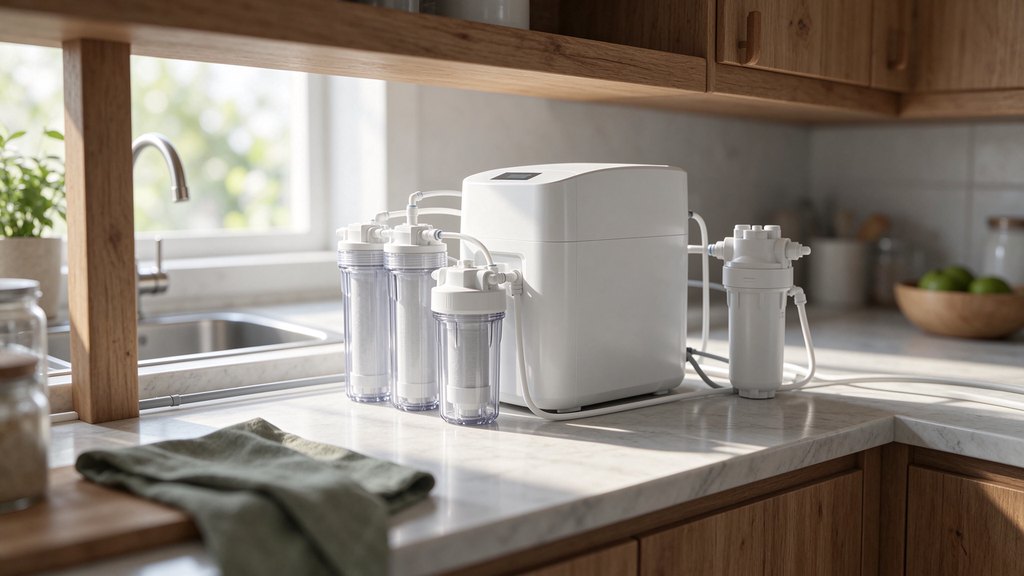
From single unit to set: water points are split up
In the past most households installed one purifier in the kitchen for both drinking and cooking. The current approach divides by point: a pre-filter at the inlet traps sediment and rust to protect downstream piping; the under-sink machine handles drinking and cooking water; a countertop dispenser filters and heats on the counter, suiting places where piping cannot be modified; a pipeline dispenser pairs with the under-sink main for hot water in the dining area or living room; shower filters treat bathing water, and commercial sites use centralized dispensing. Points differ in flow rate, filter stages and installation space, so piping reservations and site conditions should be confirmed before configuring a set.
Filtration route and cartridge materials matter more than listed features
Among drinking routes, RO reverse osmosis remains mainstream, removing dissolved salts and most contaminants; ultrafiltration keeps some minerals but removes dissolved pollutants less thoroughly. What matters over long use is cartridge material, replacement cycle and wetted-part construction: stage count and membrane specs decide filtration precision, while pump, fittings and tubing relate to leakage risk and secondary contamination; independently replaceable generic cartridges keep later maintenance costs controllable. Many products stack heating, cooling, mineralization or hydrogen functions onto the main unit; procurement should first confirm basic filtration meets the bar, then check whether added functions will actually be used.
Set support: main unit, end devices and cartridges planned together
Water equipment is not an isolated item; main unit, end dispensing devices and filter accessories should be planned in one scheme. The under-sink RO main handles core filtration, countertop and pipeline dispensers are end forms, whole-house purification covers inlet and multiple points, and cartridges and accessories decide long-term maintenance cost. In this set-based support space, Calux covers under-sink, countertop, pipeline, whole-house and shower filtration equipment; on the finished-goods side, the Under-sink RO Water Purifier handles kitchen drinking water, the Whole-house Water Purification System serves inlet and multi-point use, and the Water Filter Cartridges & Accessories support later replacement and upkeep.
| Scenario | Common device form | Selection checks |
|---|---|---|
| Main inlet | Pre-filter / whole-house system | Filtration precision, backwash method, pipe pressure rating |
| Kitchen drinking & cooking | Under-sink RO purifier | Filtration route, flow, stages, installation space |
| Countertop / living room | Countertop dispenser, pipeline dispenser | Heating method, point reservation, water-change upkeep |
| Bath & accessories | Shower filter, cartridge accessories | Wetted-part material, cartridge replaceability, consumable cost |
What this means for procurement and solution teams
Competition in water equipment is shifting from unit specs to a whole-house water scheme. Procurement should fix the filtration route by point and water quality first, then add heating or mineralization, avoiding paying for unused functions; solution teams should factor piping reservations, cartridge replacement space and later consumable cost up front. A set that ships only a main unit without reserved room for cartridges and end accessories tends to make later maintenance passive.
Comments
No comments yet. Be the first to comment.