
BOM Matching, Alternate Parts and Lead Times: What Component Distribution Actually Solves
One of the most draining parts of hardware design is landing every part number on a BOM: checking parameters, confirming packages, sourcing stock or alternates, and following up lead times and batches. Direct original supply fits mature products with stable, high-volume part numbers; small-batch prototyping, multi-category support and shortage substitution usually rely on distributors to coordinate. The value of component distribution is not simple resale, but helping the solution team complete the list and contain risk through part matching, parameter comparison, stock organization and alternate verification.
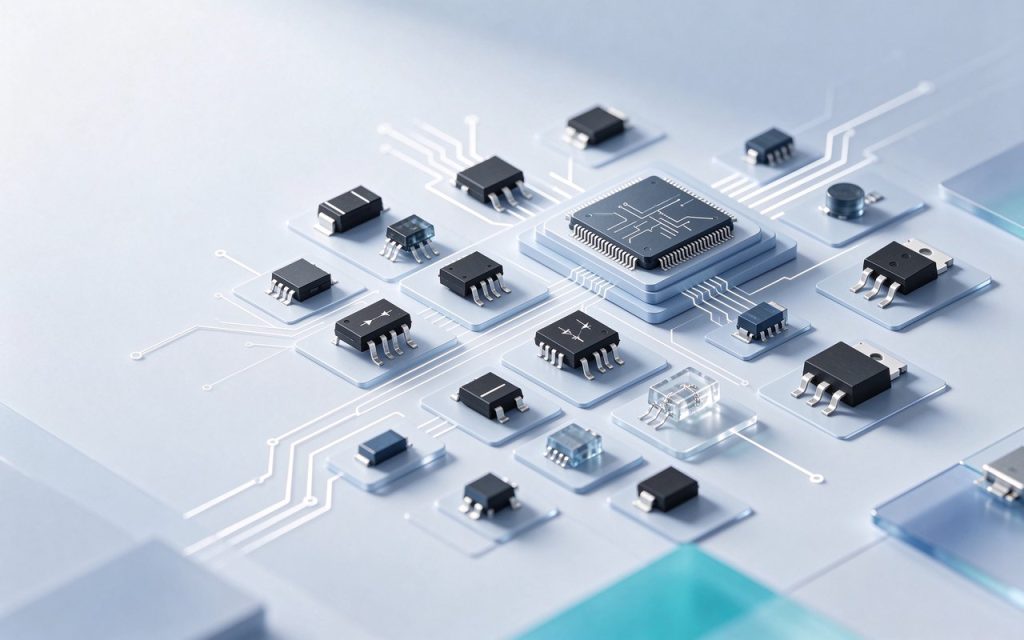
Distribution covers two device groups
By structure, distribution support splits into two groups. One is discrete devices: diodes, transistors, MOSFETs, thyristors and bridge rectifiers, power and switching components that come in many models and are selected by circuit function and package. The other is ICs and companion chips: PMICs, MCUs, sensors, DSPs, TOF modules and various interface and compute devices, matched against datasheet parameters, application circuits and compatibility. The two often appear on the same board, so package, voltage and current ratings and supply status should be checked together during BOM matching.
Alternate parts need verification, not a close-looking number
When parts are short or original lead times stretch, finding an alternate is common, but substitution is not settled by a near-matching part number. Package size, electrical parameters, temperature rating, peripheral circuit and supply stability must be compared one by one, with board validation when needed. A distributor carrying multiple lines can offer alternatives at a similar positioning and spell out parameter differences and risks. In small-batch stages, solution teams should especially keep substitution room open, so a critical device is not held to one source for lead times.
Distribution resources listed on the site
On the components side, Hongyou Electronics distributes diodes, transistors, MOSFETs, ICs, thyristors, bridge rectifiers and PMICs, carrying discrete and power-management lines under KEXIN, Sirun and AXTX brands. Taimingde distributes ICs, sensors, MCU/MPU/GPU, TOF modules, DSPs, MOSFETs and diodes/transistors, representing STMicroelectronics, Fudan Microelectronics, onsemi, Infineon and TI lines, as a reference for BOM matching and domestic alternate selection.
In practice, split the BOM into fixed part numbers and items to confirm: stable, clearly packaged parts are locked through regular channels, while parts close in parameter with substitution room are matched with alternate numbers and a parameter comparison in advance. In small-batch stages, watch batch consistency and minimum order quantity, so prototyping stock and volume supply do not drift between batches.
The real role of a distribution channel is to cover the stretch between solution and volume: part numbers, stock and lead times. Getting parameters, packages and substitution room sorted early is more proactive than hunting parts after a shortage. A reliable distributor does not only quote; it feeds back supply status, alternate differences and batch stability, helping the project contain material risk at the prototyping stage.
Comments
No comments yet. Be the first to comment.