
Common Backbone for New Terminals: How SoCs, Slim Batteries, Structures and Assembly Keep Up
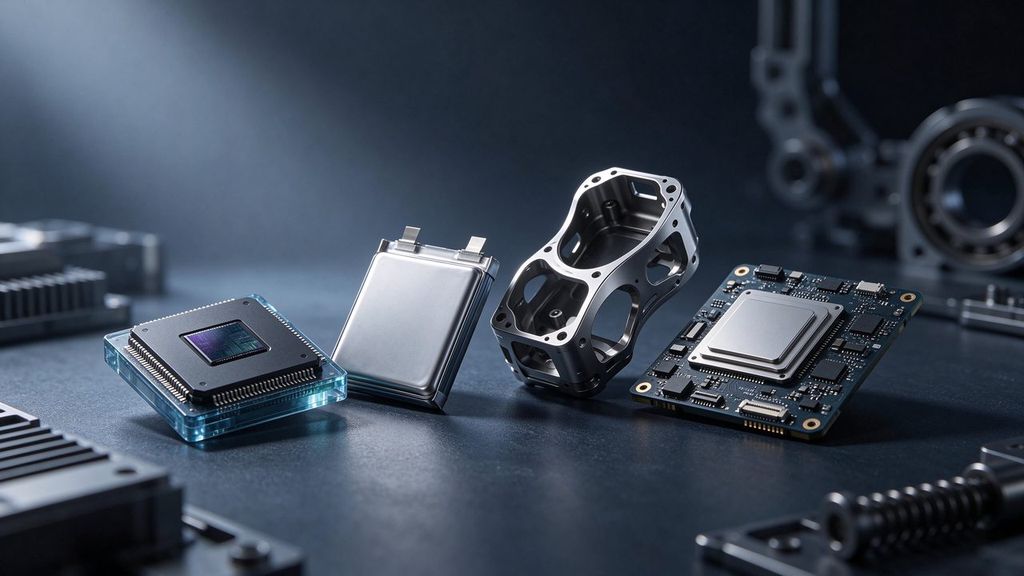
New forms such as AI glasses, watches, robots and edge terminals keep appearing. They look like different categories, but underneath they share a common hardware backbone: on-device compute chips, slim batteries, structural parts and assembly capability. As the form changes, the requirements on these components change too. Understanding this common supply chain points further ahead than looking at any single new product.
On-device compute shifts from “enough” to “local inference”
As lightweight models and multi-sensor fusion land on devices, terminal main SoCs face rising demands on compute, interfaces and power consumption; growing data volume and model parameters also push main-chip specs and unit price upward. The device is no longer just a phone accessory, with more sensing, recognition and interaction handled locally, so the main chip must balance compute, multimedia interfaces and peripheral expansion within a tight power budget. Some terminals integrate an NPU or accelerator with the main chip to run vision and voice tasks locally, cutting latency and traffic from round trips to the cloud.
Batteries squeeze energy density into very small spaces
New terminals broadly pursue thin, light, all-day wear, leaving battery space in temples, straps or body corners. Stacked-cell construction and high-silicon anodes raise volumetric energy density in limited space, with system-in-package shrinking board area; battery life remains a high-priority factor for wearable buyers, so battery, body weight and heat must be balanced together. Beyond the cell itself, BMS fuel-gauge estimation, charge-discharge protection and thermal management shrink along with the package, and capacity calibration error directly affects how credible the battery readout feels. A battery design is often co-defined with the terminal structure rather than dropping in a standard cell afterward.
Structures and assembly follow new forms with new processes
New terminals vary widely in shape, and internal structures differ substantially from a conventional phone; exterior parts use metal, glass and other materials, while newer processes such as 3D printing are explored for low-volume structural parts. Exterior parts also have to account for antenna radiation, thermal conduction and wearing feel, so material choice is often a compromise among structure, RF and thermal design. Assembly is more than fitting parts together: it needs co-design, miniaturized stacking and details in acoustics, cooling and sealing. When software and model companies build hardware, this capability usually relies on a mature supply-chain partner.
Implications for supply chain and procurement
A common backbone means the same capabilities reuse across categories: main-chip platforms, battery process, structural craft and assembly experience can migrate between terminals, yet each new form carries its own space, cooling and protection constraints. When evaluating suppliers, beyond single-component specs it is worth focusing on experience in miniaturized stacking, battery-structure co-development and mass-production consistency. New terminal categories will keep splitting, and the stable supporting capability is the one that can quickly adjust design and process as forms change.
Comments
No comments yet. Be the first to comment.