
Foldables Redefine Hinge, UTG and Midframe Structural Craft
Foldables and ultra-thin flagships have raised the bar for structural parts. Stamping, injection molding and CNC processes that were mature on slab phones have to be redefined in terms of tolerance, material and forming once they move into repeatedly bent hinges, glass only tens of microns thick, and midframes that must be both light and rigid. This shift is not just a price hike on a single component; structural parts are moving from "exterior housing" to "functional parts that carry folding stress," and the supply chain is splitting into finer specialties.
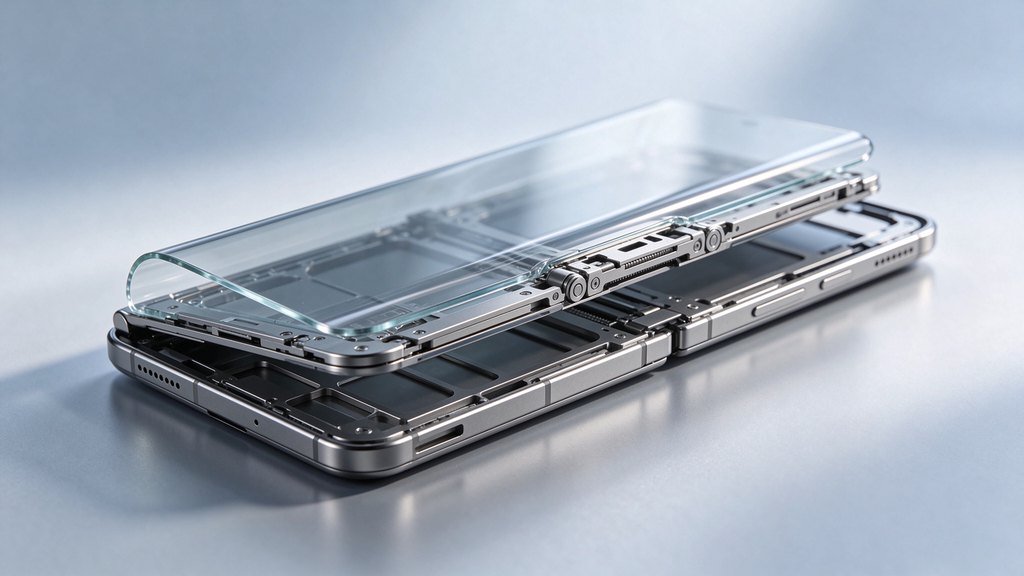
Hinges: from many small parts toward one-piece forming
The hinge carries the highest stress in a foldable. According to a Titanium Media supply-chain review in September 2026, the Apple iPhone Duo hinge is made of more than 100 components, using a variable-torque mechanism with magnetic-assisted closing; the hinge cover uses recycled-titanium 3D printing, with a titanium plate and ceramic-fiber inserts embedded for stiffness. Per-unit hinge value is clearly higher than on slab phones, with Lingyi iTech leading in hinge structures and screen support layers, and Changying Precision holding a share above 20%. On the domestic side, the OPPO Find N6 uses a titanium 3D-printed wing plate that consolidates about a dozen assembled parts into one piece, using laser-sintered lattice structures to balance strength and weight (Shenzhen 3D Printing Association, March 2026). Ramp-up yield on hinges remains a shared industry challenge. A September 2026 Tonghuashun report citing supply-chain sources put early yield on some models between roughly 30% and 65% before climbing closer to launch; specific figures still await third-party teardowns.
Ultra-thin cover glass: stress management at tens of microns
The UTG (ultra-thin flexible glass) on a foldable display is thinned to around 30 microns, and a single micro-crack can scrap an entire finished sheet. According to Biel Crystal's process disclosure in November 2026, edge chamfering redistributes bending stress, slot-die coating reaches sub-micron precision, and ion-exchange strengthening builds a surface compressive-stress layer, enabling a 0.4 mm bending radius and 500,000 dynamic folding cycles without a visible crease. Samsung's latest Galaxy Z series uses a Flex Titanium approach: a titanium plate beneath the display acts as the primary structural support, absorbing front-to-back pressure and impact, while a titanium-alloy film only tens of microns thick—about one-third the diameter of a human hair—provides strength, flexibility and elastic recovery, with a lattice structure formed by a hybrid manufacturing process (Samsung Newsroom, August 2026). The cover and support layer are no longer two independent materials; they must be co-designed around bend radius, spring-back and impact resistance.
Midframes and exterior parts: combining materials and forming processes
A CICC industry view in November 2026 noted that next-generation flagships may use 3D glass on front and rear covers, with titanium-alloy midframes combining 3D printing and CNC. For structural suppliers, this means a single part must handle metal, glass and ceramics together, and tolerance fit, surface treatment and assembly consistency are far stricter than on slab phones. For enclosures and precision molds used in laptops, tablets and AI mini PCs, laptop and tablet enclosures, parts and molds can combine injection molding, stamping and CNC to match stacking space and appearance requirements. For wear-resistant, heat-resistant or lightweight irregular-shaped small parts, precision ceramic and metal custom parts cover zirconia, alumina and silicon nitride ceramics alongside stainless-steel and titanium-alloy CNC parts, suitable for one-piece and small-batch custom work to drawing.
| Role | Main function | Process difficulty |
|---|---|---|
| Hinge | Carries repeated bending stress; controls opening torque and closing gap | Many parts with tight fit tolerances; 3D printing and one-piece forming replace some assembly |
| UTG cover | Provides bendable surface protection and a flat visual finish | Only tens of microns thick; stress managed by chamfering, coating and ion exchange |
| Midframe and support | Chassis rigidity, heat conduction and exterior outline | Combines titanium, glass and ceramics; demanding forming and surface-treatment consistency |
What this means for procurement and solution teams
Structural parts for foldables and thin terminals can no longer be priced as exterior housing alone. Selection should evaluate folding life, material grade, forming process and assembly tolerance together: hinge parts are judged on torque consistency and fatigue cycles, cover glass on bend radius and surface strength, and midframes on material combination and thermal fit. For small-batch irregular parts, prototyping first to validate assembly and surface finish before scaling; the structural solution should enter at the chassis-stacking stage rather than after the exterior shape is locked.
Comments
No comments yet. Be the first to comment.