
Home Backup Drives Portable Power Demand in North America
Ahead of the 2026 Black Friday and Cyber Monday stocking season, one category originally associated with outdoor use is gaining traction in North America: portable power stations and solar-generator units. Several flagship models sold out within days of launching in early November, with restocking pushed to late November and some models not fully available again until early next year. Unlike most consumer electronics categories still working down inventory, demand here is shifting from camping and RV trips toward the more essential use case of household emergency backup.
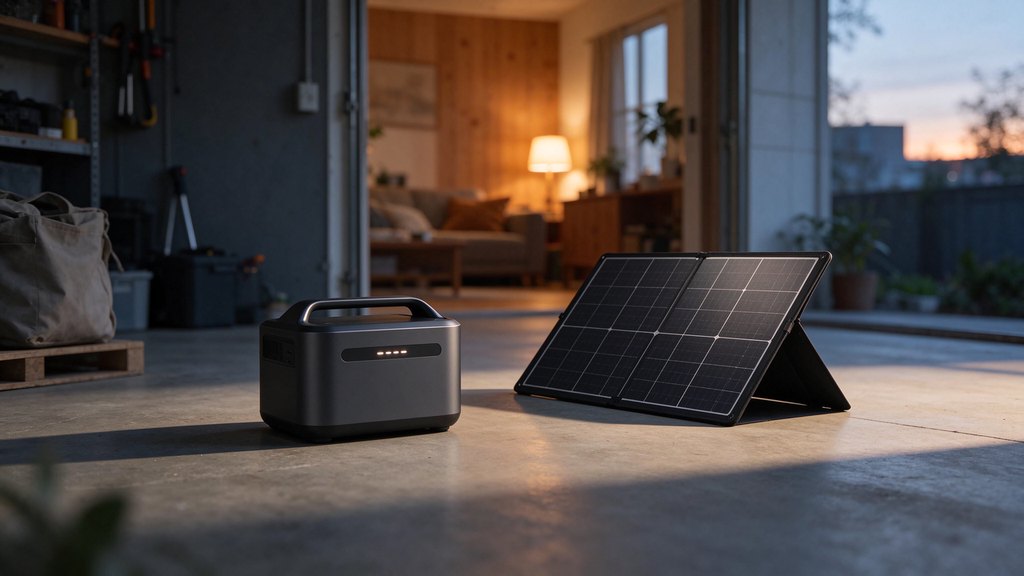
Buying signal: single-week retail growth spikes
According to CleanTechnica's November 6, 2026 report, among the Black Friday/Cyber Monday models launched by portable power brand Jackery on November 1, several units across the 1000, 2000, 3600 and 5000 Wh lines were essentially sold out within three days, with later orders moving to preorder status. Channel figures show the strength of the demand: in the week of October 19–26, the brand's retail sales at Costco rose 755% week on week, from 2,379 to 20,343 units; Walmart grew 106%, Home Depot 297% and Lowe's 442%. The report notes this was not a limited-edition stunt, but a broad demand pull that tightened inventory.
Where the demand comes from: backup power becomes a household line item
The underlying driver is rising concern about power reliability in North American households. Across 2026, winter storms, summer heatwaves, wildfires and autumn maintenance events caused staged outages in several regions, while AI data centers, electrification projects and new manufacturing load keep climbing, putting sustained pressure on the grid. Preparedness awareness is also spreading: public reports note that at least 17 countries advise households to store three to seven days of food, water and emergency supplies, with backup power included. On the policy side, residential storage credits under the U.S. Inflation Reduction Act and grid-resilience spending lower the cost threshold for home energy equipment. On the technology side, falling LFP cell costs together with better inverter and fast-charge efficiency are bringing larger, solar-pairable units within reach.
Market size and capacity tiers: analyst bases differ
Several institutions publish growth forecasts, but their scopes and base years differ, so trends and ranges should be read separately from absolute figures. Fortune Business Insights' October 2026 report puts the global portable energy storage market at about US$5.03 billion in 2025 and US$6.40 billion in 2026, reaching US$32.07 billion by 2034 at a CAGR of about 22.34%; North America held roughly 36.6% of the global total in 2025, about US$1.84 billion, of which the U.S. market was about US$1.52 billion and is forecast near US$1.92 billion in 2026. Under Grand View Research and SNS Insider bases, North America accounted for about 40.8% of 2025 revenue, with the U.S. around 84.6% of the North American market. Institutions define market boundaries differently—whether fixed home storage and solar panels are included—so absolute values should not be compared directly, but North America as the largest regional market with growth in the low twenties percent is a broadly consistent read.
| Tier | 2025 share | Typical retail range | Channel and use case |
|---|---|---|---|
| 3–5 kWh entry | 34.2% | US$500–1,400 | Mass retail, e-commerce; camping and light backup |
| 5–10 kWh mid-range | 42.5% | US$1,200–2,800 | E-commerce and DTC; home backup, solar pairing |
| 10 kWh+ premium | 23.3% | US$2,500–6,500+ | DTC and installer channel; whole-home backup, parallel expansion |
Implications for products and the supply chain
Product and design side
- Home backup use cases emphasize sustained output, expandability and safety redundancy; cell cycle life, BMS protection and parallel stability are the review priorities
- Solar pairing, fast charging and silent running sell across both outdoor and home scenarios, while operation should be simplified for ordinary household users
Procurement and channel side
- North American channels concentrate in large retail chains and e-commerce; peak-season stocking, inventory turns and after-sales spares need early planning
- Exports must clear local safety certification, EMC and battery transport requirements; high-capacity units also depend on channel installation and service capability
Overall, this upturn is not a simple peak-season promotion; household backup demand has been pushed to the forefront by grid-resilience concerns and preparedness awareness. Near term, watch actual holiday sell-through and channel restocking pace; longer term, watch larger-capacity models, solar pairing and the blurring boundary between portable and home storage. For the supply chain, the combined capability around cells, inverters, BMS and structural parts will matter more than a low unit price alone in determining competitiveness.
Comments
No comments yet. Be the first to comment.