
AI Compute Shifts from Single Servers to Rack-Scale Delivery
The way AI compute capacity is being bought is quietly changing. Where customers once picked servers one by one, comparing CPU, memory and drive bays per unit, high-density clusters are increasingly configured and delivered as whole racks that bundle compute nodes, node-to-node interconnect, power delivery and in-rack cooling together. The rack is no longer just a physical container in the data center; it is becoming the delivery unit of compute procurement. To follow this shift, it helps to see how the supporting components are selected alongside the rack rather than on their own.
Demand: from stacking chips to rack-scale system packaging
East-west traffic inside AI clusters and power draw per rack are both climbing, and adding more GPUs or CPUs alone no longer solves the problem. According to a report by Securities Daily on November 14, 2026, IDC China's liquid-cooled server tracker shows that vendor revenue in China's liquid-cooled server market grew 153.1% year on year in the first half of 2026, with shipments forecast to grow at a compound annual rate close to 49% over the next five years. High-density projects are no longer selected by the unit; nodes, interconnect, power and in-rack liquid cooling are delivered as one system, with cold plates, piping, quick connectors, the CDU (coolant distribution unit) and leak detection pre-integrated and validated at the factory.
Interconnect is also iterating faster. A review by TMTPost on November 10, 2026 notes that supernodes are moving into volume delivery; orthogonal direct connect and backplane-less architectures raise the use of high-speed connectors, with rates moving from 56G toward 112G and 224G, while liquid cooling has become almost standard on supernodes. Downstream demand has not cooled: Tencent News reported on October 21, 2026 that Supermicro raised its revenue guidance, attributing the revision mainly to stronger AI platform demand, and Hon Hai gave a high-double-digit growth outlook for AI racks in 2027 alongside its Q3 2026 results.
Selection: unit-price comparison gives way to rack-level fit
Rack-scale delivery changes how supporting parts are assessed. On a compute mainboard or accelerator card, material grade, stack-up design, impedance control and temperature rise directly affect signal integrity and long-term reliability; heavy-copper boards and power modules in the power path have to carry larger currents, and the thermal path has to work with cold plates and piping. Comparing boards and cards only by unit price tends to push negotiation too far on critical parts, where later rework and validation can cost far more than the upfront saving.
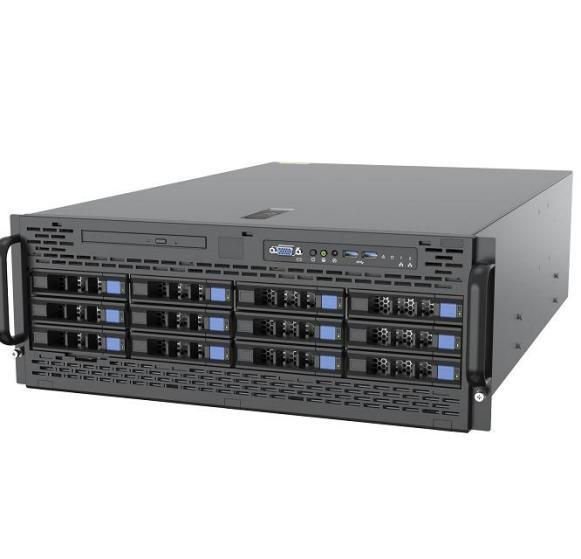
The platform listed here, the NSR7936 dual-socket Kunpeng AI server, targets AI inference, fine-tuning, local knowledge bases and HPC workloads; the network expansion modules and accelerator cards (DPU / NIC / QAT) handle front-end network expansion, DPU acceleration and crypto-compression offload; the compute power board / heavy-copper board (power module · power board) covers the power and power-board stage. These entries can be checked against the rack's power budget, interconnect and cooling requirements separately, rather than judged as isolated individual models.
| Dimension | Per-server selection | Rack-scale compute delivery |
|---|---|---|
| Procurement unit | CPU, memory and bays assessed per machine | Nodes, interconnect, power and cooling packaged per rack |
| Component focus | Individual specs and unit price | Whole-rack power, interconnect rate and thermal coordination |
| Validation | Single-machine bring-up and basic tests | Factory pre-integration with piping and leak detection validated as a set |
| Main risk | Pushing price down erodes margin and reliability | Supporting parts mismatch the rack and trigger rework |
What this means for procurement and solution teams
For solution and procurement teams, the next move is to shift attention from "choosing one good server" to "assembling a rack that runs stably." Define rack power, interconnect topology and cooling form first, then go back to selecting mainboards, power boards, accelerator cards and interconnect modules; the supplier's reliability track record and how well its parts fit the rack matter more than the individual quote. AI compute demand is still in an expansion cycle, but the structural upside sits more with suppliers that can deliver system-level support rather than compete only on price.
Comments
No comments yet. Be the first to comment.