
Vehicle EE Architecture Consolidation: From Distributed ECUs to Domain and Central Compute
The electrical/electronic architecture of smart vehicles is consolidating structurally. Where a car once ran on over a hundred distributed ECUs, functions are now being grouped into domain controllers and then into central compute with zone control. Cockpit and ADAS — the two most compute-hungry domains — are merging first, and cockpit-ADAS integration has become the key step toward central compute. For automotive electronics buyers and solution teams, this means controller count, harness layout, sensor integration and software delivery must be re-planned along with the architecture, rather than simply swapping in a stronger chip.
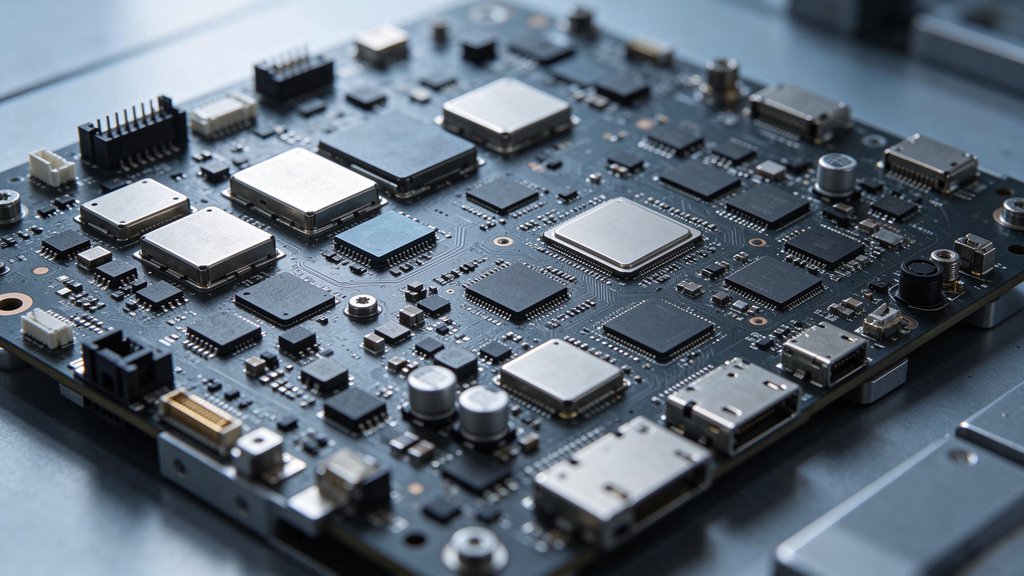
From distributed ECUs to central compute, in three consolidation steps
In the early distributed architecture, each function had its own independent ECU with its own chip, memory and software, and a vehicle could carry well over a hundred controllers. As features piled on, harness weight, communication latency and development complexity became hard to manage. The recognized path is: first group functions into domain controllers for powertrain, cockpit, ADAS and body; then concentrate compute on a central compute platform that collects data and commands actuators through zone controllers. Commercial vehicles follow the same domain-consolidation route, replacing scattered ECUs with fewer domain processors to support whole-vehicle OTA, V2X and unified cybersecurity.
| Stage | How compute is organized | Main traits |
|---|---|---|
| Distributed ECUs | One independent controller per function | Many controllers, complex harness, weak cross-domain coordination |
| Domain consolidation | Grouped by powertrain/cockpit/ADAS/body domains | Fewer ECUs, domain-level scheduling, OTA ready |
| Central compute + zones | Central platform decides, zone controllers connect locally | Concentrated compute, cross-domain data, software-hardware decoupling |
Cockpit-ADAS integration: merging the two compute-heavy domains first
Cockpit and ADAS used to run as two separate computing systems, each with its own chip, memory, cooling and harness. Cockpit-ADAS integration combines both onto a single SoC, sharing a memory pool and underlying software, cutting hardware redundancy and lowering cross-domain latency. Citing GGII, CNR reported that an integrated cockpit-ADAS architecture can reduce vehicle cost by roughly 30% versus a split design; Horizon's integrated chip solution noted smaller space use, lower per-vehicle cost and a shorter development cycle under a unified memory and software stack (sources: Xinhua News, CNR, April–May 2026). On deployment, Qualcomm's Snapdragon Ride Flex platform is in series production with multiple design wins, while NVIDIA, MediaTek, SiEngine and Black Sesame are advancing their own integrated platforms.
Drivers and deployment limits
Three forces drive consolidation. First, squeezed vehicle margins push BOM reduction by removing redundant hardware and harness. Second, on-device large models and physical AI entering the car require concentrated compute scheduling and cross-domain data, which a split architecture cannot easily support. Third, smart features keep moving down-market, with entry-level models now standardizing cockpit and driver-assist functions, calling for a flexible, extensible platform. That said, cockpit-ADAS integration places higher demands on chip compute, functional safety, real-time performance and software maturity; vendors take different routes, some starting from entry-level cars, others validating first on premium platforms, so the upgrade is not a single-step switch.
Judgment for buyers and solution teams
Architecture consolidation reshapes the automotive electronics supply structure: demand for standalone small controllers contracts, while domain controllers, central compute platforms, zone controllers and automotive Ethernet gain importance, with sensors and actuators connecting more through zone nodes. Beyond chip compute, selection should weigh functional safety rating, cross-domain communication and real-time performance, software cross-generation migration, and headroom for later feature expansion. On the supply side, vendors that can deliver domain or zone control solutions and co-integrate software and hardware sit further forward in this shift; suppliers that only stack single-point controllers face pressure to be integrated away.
Comments
No comments yet. Be the first to comment.