
MicroLED Reaches Near-Eye Displays and Vehicle Glass
MicroLED has drawn a lot of attention over the past two years, but what actually gates its adoption is not a single spec like brightness or pixel density—it is full-color capability and mass-production yield. As Q4 2026 begins, near-eye displays and vehicle glass are the first two scenarios pushing MicroLED into mass-production discussions: AR glasses are looking for a next-generation light engine lighter and brighter than micro-OLED and LCoS, while automakers are trying to embed display cells into window glass. The direction is clear, yet between lab samples and scaled delivery lie hard problems in red efficiency, mass transfer and color combining.
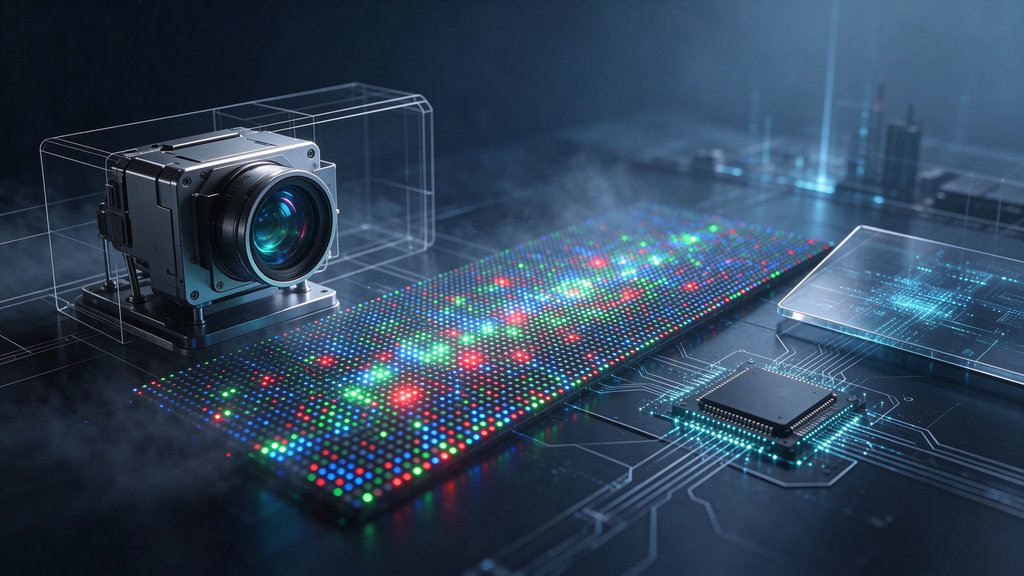
Near-eye displays: miniaturized engines first, full color still the bottleneck
AR glasses impose harsh constraints on display modules: brightness for outdoor readability, a small enough engine to fit the temple, and a light enough weight for all-day wear. With high brightness, fast response and compact pixels, MicroLED is seen as the long-term route after LCoS and micro-OLED. Recent domestic suppliers disclosed volume production on a 2.5-micron-class pixel platform, a chip die around 0.06 inches, and an engine module under 0.1cc, already shipping in mass-produced consumer smart glasses. Overseas device makers have also reported MicroLED-array RGB engines reaching mass-production-readiness milestones.
Yet moving from a single color to full color is a different hurdle. Red-chip efficiency and yield have long been the weak point, and red, green and blue must be combined inside a tiny engine, putting heavy demands on bonding, pixel alignment and rework rates. The industry broadly treats "full color" and "volume production" as the two prerequisites for AR display to go mainstream—neither can be missed.
Several engine routes coexist; no single winner soon
For procurement and solution teams, it is worth noting that near-eye display is not a one-way bet on MicroLED. LCoS keeps shipping in today's mainstream models thanks to maturity and cost, micro-OLED holds its ground on contrast and resolution, and laser scanning and retinal projection are still being explored. MicroLED's opportunity concentrates in the most demanding segments for brightness, size and response, rather than taking over every model in the short term.
| Route | Current state | Better-fit direction |
|---|---|---|
| LCoS | Mature process, stable supply chain, relatively controllable cost | Current mainstream consumer and business AR glasses, cost-sensitive models |
| micro-OLED | Strong contrast and resolution; brightness and power still being optimized | Display glasses prioritizing image quality in relatively controlled lighting |
| MicroLED | High brightness and miniaturization potential; full-color yield and combining still maturing | Outdoor high-brightness, lightweight engines and long-term upgrades like vehicle glass |
Vehicle glass displays: start with prompts, not a replacement for the main screen
Beyond glasses, the vehicle is another frequently discussed landing scene. The concepts automakers show embed mini LED and MicroLED cells into laminated glass: nearly invisible in normal use, they can show warning messages on the rear window or charging status on side windows when needed. These applications involve small pixel arrays and simple content, so they tolerate yield and cost better than full-color near-eye displays and are more likely to arrive first.
Judgments for solution and procurement teams
In the near term, MicroLED fits best as a reserve direction to track for next-generation engines, rather than the default choice for today's selection. When evaluating a project, separate monochrome prompts and signage from full-color imagery: the former impose lower demands on red and color combining and move faster, while full-color near-eye displays still need time for device maturity and supply-chain validation. When vetting suppliers, focus on single-chip yield, bonding and transfer processes, and proven shipping engine cases, rather than paper brightness and pixel specs. Small-pixel applications like vehicle glass can start with prompt-type functions and build process and reliability data over time.
It also helps to separate device progress from end-product hype. A chip vendor announcing a smaller pixel pitch or a new bonding line does not automatically mean a finished eyewear engine is ready; between wafer processing, array transfer, color combining and optical coupling, each stage can introduce its own yield loss. Teams planning a 2027 or 2028 product should keep a parallel path on mature LCoS or micro-OLED engines as a fallback, and watch for supplier milestones such as qualified color-combining processes, delivered reference engines and repeatable mass-transfer yield before locking the display route. On the automotive side, embedded-glass displays are still largely concept and low-volume demonstration today, so reliability over temperature cycling, vibration and long-term transparency remains to be proven in production vehicles.
Comments
No comments yet. Be the first to comment.