
Agent Workloads Reshape Server Ratios: Why CPU and Memory Channels Gain Weight
As AI workloads move from model training to inference and agents, the compute ratio inside servers is being rewritten. In the past, when buying a training server, budget and review centered almost entirely on GPUs, with CPU, memory and network matched to a fixed topology. In agent scenarios, however, a large share of task scheduling, tool calling and multi-turn interaction lands on general-purpose processors, turning the CPU from a supporting role into a scheduling hub, while memory capacity and channel counts rise with it. For solution and procurement teams, CPU socket count, memory expansion and interconnect headroom must be assessed separately rather than treated as an appendix to the GPU spec.
Workloads shift from training to inference and agents
In pre-training, dense matrix math dominates and GPUs carry the main floating-point compute, while CPUs mostly handle data loading, preprocessing and post-processing. As applications move from single-shot generation to multi-turn interaction, long context and multi-agent collaboration, inference and agent workloads keep rising. In these workloads, token generation still suits GPUs, but task planning, request routing, tool calling, sandbox execution and coordination between agents involve many branch decisions and external interactions, which today are carried mostly by general-purpose CPU architectures. As the workload mix changes, the ratio logic inside servers has to change with it.
Training and centralized compute side
- Workload is dominated by dense matrix math; GPUs carry the main floating-point compute
- CPU focuses on data loading, preprocessing and post-processing, matched to a fixed topology
- Ratio typically one CPU to seven or eight GPUs
Inference and agent side
- Scheduling, routing, tool calling and multi-agent coordination land on general-purpose processors
- CPU handles orchestration, sandbox execution and real-time response, gaining weight
- Ratio moves from about 1:8 in training and 1:4 in inference toward roughly 1:1 in agent scenarios
Memory and interconnect expand along with the CPU
As CPU weight rises, the pull goes beyond the processor itself. In industry discussion, memory per server CPU is moving from the 96–256GB band to 300–400GB, and next-generation platforms support memory channels rising from 8–12 to 16–24, which in turn lifts demand for DRAM, memory modules, PCIe Retimers and CXL interconnect chips (source: Eastmoney and Shanghai Securities News, September–November 2026). The processors themselves are also upgrading: server CPU core counts have climbed from the low twenties to several hundred cores, and the memory subsystem has moved from DDR4 to DDR5, doubling platform bandwidth and capacity. If the CPU or memory cannot feed data fast enough, even a strong GPU sits waiting.
Impact on mainboard and platform selection
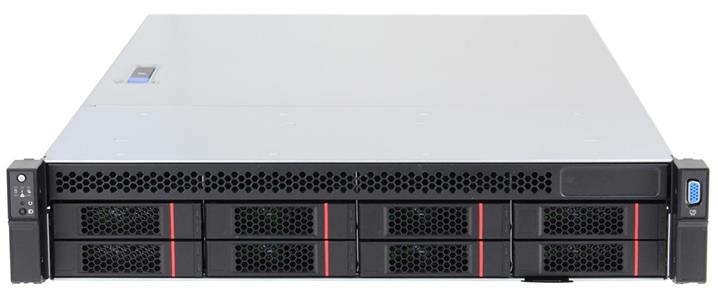
In hardware selection, when evaluating an inference or agent platform, CPU socket count, memory slots and onboard-memory scheme, expansion slots and interconnect capability should be checked as a separate item, not as an appendix to the GPU configuration. Centralized compute nodes focus on dual-socket mainboards, memory capacity and multiple drive bays; edge inference and access scenarios emphasize platform form factor, wide-temperature power and on-site deployment. In this server mainboard, system and edge platform space, XINGHAN covers multi-architecture server hosts and edge systems: the NSR7930 Kunpeng Single-Server Mainboard serves single-socket platforms for edge computing and AI inference, the NSR7230 Kunpeng 2U Server targets general compute nodes and distributed storage, and the Atom / ARM Edge Gateway Platform Series handles edge access and industrial IoT scenarios.
The essence of this ratio shift is that AI server value assessment has moved from peak single-chip compute to effective task output and end-to-end efficiency. Buyers should not apply training-era topology to inference and agent nodes; memory expansion, interconnect slots and alternative architecture should be reserved early. Changing CPU socket count or memory scheme after entering the prototype stage often pulls in mainboard structure, cooling and software adaptation. Different workloads demand different CPU, memory and GPU balances, and splitting platform configuration by the actual business profile is more controllable than pursuing a uniform high spec.
Comments
No comments yet. Be the first to comment.