
Inference Hardware Aligns with Existing Rack Power and Cooling Before a Datacenter Rebuild
AI compute first brings high-power racks and liquid cooling to mind, but that belongs mostly to training. Inference workloads are landing on-premises, in workshops and at edge sites—places that usually cannot build a new datacenter, where power, cooling and rack space already exist. A new generation of inference hardware fits those existing conditions first, ranking efficiency and deployment constraints ahead of peak compute. For solution and procurement teams, checking room for headroom before choosing hardware lands better than comparing chip TOPS alone.
Why inference lands on-premises and at the edge
Training needs massive parallel data and high-throughput clusters, centralized in large datacenters. Inference disperses to where the business happens: workshop inspection, campus video analytics, retail interaction and equipment monitoring prefer processing close to the source, cutting backhaul latency and bandwidth while keeping sensitive data controlled. These workloads do not always need the highest single-machine compute, but they are numerous and spread out, demanding more on size, power draw, environmental tolerance and long-term stability.
Recent inference chips echo this. Axelera's third-generation Titania architecture scales to a 400W class, with a 6kW server that fits existing 20–30kW air-cooled racks, so AI acceleration can be added without rebuilding the room; its in-memory computing targets performance per watt. MemryX's MX3+ addresses edge devices, industrial systems and high-density inference, combining multiple chips as one logical device for higher-resolution vision, Transformers, small language models and vision-language-action workloads; sampling and production stay on the roadmap.
Hardware aligns with rack power and cooling first
Power circuits, air conditioning, rack loading and cabling in existing rooms and closets were planned for traditional servers and network gear, with limited headroom. A high power-density card can collide with power, cooling and space at once. Local-deployment designs therefore set per-unit power, air-cooling fit, noise and size as prerequisites before adding compute, rather than stacking peak specs and solving cooling later. Fitting a rack does not mean cooling can be ignored: inlet temperature, airflow, heat stacking and sustained-load throttling need checking before deployment; industrial sites add wide temperature, dust, vibration and power fluctuation.
| Dimension | Training cluster | Inference / edge deployment |
|---|---|---|
| Power and cooling | High density, often liquid-cooled with dedicated power | Fits existing air cooling and headroom; controls unit power and noise |
| Site conditions | Centralized in large datacenters; infrastructure planned around compute | Dispersed across rooms, workshops, stores and outdoor sites |
| Selection focus | Peak compute, cluster interconnect and large throughput | Efficiency per watt, I/O, environmental tolerance and long-run OPEX |
Common edge hardware forms and selection
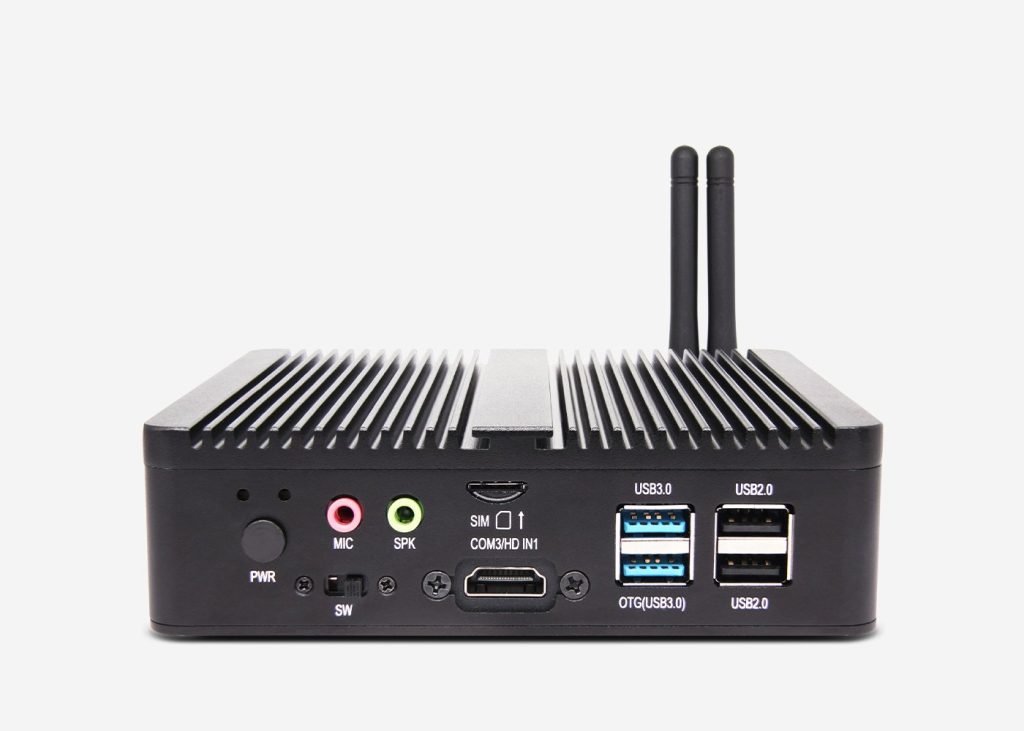
Local inference takes three common forms: a desktop or DIN-rail edge box ingesting video or sensor streams for local analysis; an industrial gateway focused on serial ports, bus access and device networking; and a core board / module for OEM integration. An ShiMeta AIBOX-3588M Edge AI Computing Box suits edge video analytics, signage and industrial integration; the MYIR MYD-LR3576-B Industrial Edge Computing Box targets field trials for industrial edge, AIoT gateways and multimedia; the METO AI3399Pro Industrial Edge AI Gateway focuses on device networking, instrument acquisition, building control and lightweight vision; for compute inside a self-developed device, the METO M88 RK3588 Industrial System-on-Module bases industrial HMIs, multimedia terminals and edge AI devices.
Judgments for procurement and solution teams
Start with a site audit: available circuit power, whether cooling supports added equipment, rack space, and temperature, humidity and dust at industrial points. Once clear, choose between edge box, gateway or core board and how much compute to allocate; selecting by peak compute first often leads to hardware that cannot fit the rack or hold temperatures. Model adaptation and long-term O&M count into cost: edge models usually need quantization, pruning and scene tuning, with remote upgrades, fault monitoring and spares after deployment. Beyond compute specs, weigh I/O richness, industrial reliability, software support and lead time. For SMEs and integrators, a flexible solution that reuses existing room conditions and scales gradually is steadier than a one-time high configuration.
Comments
No comments yet. Be the first to comment.