
Miniature Sensors in Probes: Medical and Industrial Endoscope Modules
Endoscope imaging is moving toward the probe tip: image sensors keep shrinking, while signal transmission and image processing concentrate in the module and decoder board. In late October Sony Semiconductor Solutions announced a 1mm-square CMOS image sensor for single-use medical endoscopes, supporting digital output over a 5-meter cable to carry high-definition images back to the backend. Behind this move, both single-use medical and industrial inspection endoscopes are heading toward miniaturization, higher definition and edge processing, raising new checks for module and system support.
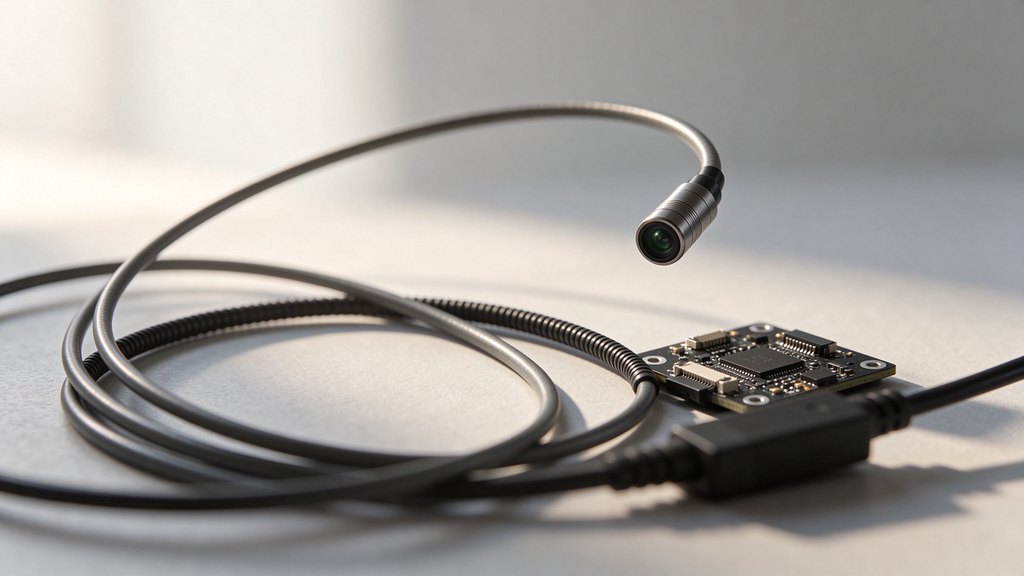
Sensor miniaturization: probe diameter and image quality compressed together
Endoscope probes enter narrow lumens or equipment gaps, so diameter is constrained and the sensor and surrounding circuits must shrink with it. Sony's IMX742 has about 0.51 effective megapixels; by miniaturizing peripherals such as the A/D converter, it balances image quality and stable transmission in a small size. Demand for single-use endoscopes rises mainly to lower cross-infection risk and reduce instrument reprocessing burden. Single-use scenarios put higher requirements on probe cost, disposable structure and imaging consistency; industrial inspection endoscopes focus more on bend resistance, probe wear resistance, defect clarity and side-view capability. The two scenarios differ in sensor specs, lens angle and lighting trade-offs.
Signal transmission and backend decoding: a module is more than one sensor
The endoscope imaging chain is a complete combination of probe sensor, cable transmission, backend image processing and display or storage. The sensor sets front-end capture, the cable sets transmission distance and noise immunity, and the backend decoder board handles image processing, dimming, interface output and system integration. Pushing AI inference into the module or backend board is also a recent direction, such as on-device real-time annotation and assisted recognition, reducing reliance on an external workstation. A system scheme should match sensor selection, cable transmission, decoder processing and display output together, rather than picking a sensor alone.
Support focus by scenario and matching in-house resources
Single-use medical endoscopes focus on imaging consistency, sterilization and disposable structure; industrial inspection endoscopes focus on probe durability, high definition and side-view observation. In imaging capture and system support, Chenhan Digital covers document cameras, binocular dual-recording, industrial and depth cameras, endoscope decoder boards and consumer cameras; on the finished-goods side, the Industrial Borescope Cameras target internal defect and gap inspection, and the Medical Endoscope Unit & Decoder Board provides backend image decoding and handheld system support, compatible with a range of medical endoscope sensors.
| Item | Single-use medical | Industrial inspection |
|---|---|---|
| Core need | Consistent imaging, low infection risk, disposable | Durable probe, clear defects, reusable |
| Probe form | Small diameter, disposable structure, consumable role | Bend- and wear-resistant, side-view and multiple lenses |
| Backend processing | Dimming, imaging decoding, system integration | HD output, defect annotation, storage interface |
| Support checks | Sensor consistency, sterilization compatibility, cost | Cable immunity, probe life, lighting match |
What this means for procurement and solution teams
Endoscope system selection should not look only at sensor pixels; probe size, cable transmission, decoder processing and scenario durability should be assessed as one set. Single-use medical projects focus on imaging consistency, sterilization compatibility and consumable cost; industrial inspection projects focus on probe life, side-view capability and defect clarity. Solution teams should define backend decoding and interface needs early; adding image processing and display after the probe is finalized often pulls in structure and system re-adaptation.
Comments
No comments yet. Be the first to comment.