
On-Device SoCs Carry Local Inference to Edge Devices
Not all AI compute lives in the cloud. When physical AI—robots, vehicles, smart terminals—has to perceive, reason and act in the real world, the key computation often has to run on the device itself; latency, privacy and offline availability do not allow every step to be sent back to a data center. That local inference is carried by on-device SoCs and the terminal forms built around them: mini PCs, 2-in-1 tablets and edge gateways. What matters in this shift is which devices local inference is pushing compute into, and what should be checked when selecting them.
Background: physical AI pushes latency and reliability back on-device
A review by Stockstar on November 1, 2026 describes physical AI as AI driving robots, vehicles and other physical devices to perceive, reason, decide and act in real environments; such scenes are latency-sensitive, and the critical computation has to be completed locally on the device. The on-device SoC is the main controller taking on this work. Q3 reports from A-share chip makers offer indirect evidence: vision AI SoC vendor SigmaStar reported Q3 2026 net profit attributable to shareholders of 701 million yuan, up 752.76% year on year; edge AIoT chip vendor Rockchip reported 473 million yuan over the same period. Behind this earnings elasticity is rising demand for local main-control compute in smart hardware and industrial settings.
The terminal forms are also changing. In its on-the-ground notes at IFA Berlin 2026, IDC recorded GEEKOM linking four A9 Mega mini PCs over USB4 into a single system, powered by an AMD Ryzen AI Max+ 395 processor, running a large model locally without relying on traditional server infrastructure. Long-term shipment expectations for edge AI chips are being revised upward; institutions forecast global edge AI chip shipments to exceed 2 billion units by 2028 (IDC figures relayed by ijiwei, a forecast range).
| Dimension | Centralized cloud inference | On-device local inference |
|---|---|---|
| Latency | Affected by network round-trip, limited for real-time action | Closed loop locally, fast response, suited to perception and control |
| Data | Raw data uploaded, heavier privacy and bandwidth pressure | Data stays on the device, more controllable in sensitive scenes |
| Deployment | Depends on data centers, clusters and network conditions | Runs near the point of use across terminals, gateways and field devices |
| Typical forms | Large-model training, batch data analysis | Robotics, automotive, security, industrial and desktop terminals |
Forms: local compute lands in mini PCs, tablets and gateways
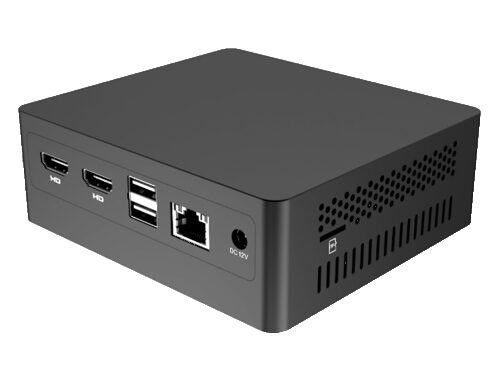
Local inference is not one device's job; it is split across forms by scenario. Desktop and edge deployment needs small, low-power hosts that stay on long-term; mobile field work, education and paperless settings need touch tablets; access, small cells and industrial IoT need highly reliable edge gateways. Selection focus moves from appearance and size to main-control compute, power behavior, expansion interfaces and the stability of local deployment.
The listed Mini PC series (H13, H09, H03, H04, H11, H12, H15, H10) covers home theater, desktop office, industrial control, digital signage and lightweight server use cases; the 2-in-1 convertible / tablet series targets teaching, business presentation, mobile field work, retail checkout and paperless office; the Atom / ARM edge access gateway platform series (NSA / DTA / DTB / DNA / DNB / MT) serves internet access, 5G small cells, edge computing and industrial IoT high-reliability compute. The on-device intelligence around these can also be assessed together with voice interaction and acoustic detection solutions.
Procurement judgment: define the scenario first, then the SoC and form
For solution and procurement teams, split the scenario clearly first: which loops must close locally and which can return to the cloud, then work backward to the main-control compute, memory and expansion the terminal needs. On-device equipment is not simply a shrunken cloud server; it balances compute under power, thermal and cost constraints, so headroom in the main control, interface expansion and long-term supply matter more than a single benchmark score. Local inference will keep moving down into terminals, but whether it lands depends on device stability in real scenes, not on paper compute in the spec sheet.
Comments
No comments yet. Be the first to comment.