
GaN Chargers Become Multiport Desktop Power Hubs: Allocation and Sizing
With phones, tablets, earbuds and laptops sharing one desk, chargers are shifting from a single-device plug to a multiport hub that tops up several devices at once. As GaN raises power density, multiport desktop chargers have become the fastest-growing segment, and the buying focus has moved from single-port wattage to port allocation, protocol compatibility and thermal control. For accessory buyers and solution teams, mapping the desktop device list to power tiers first, then checking dynamic allocation and heat, matters more than comparing peak watts alone.
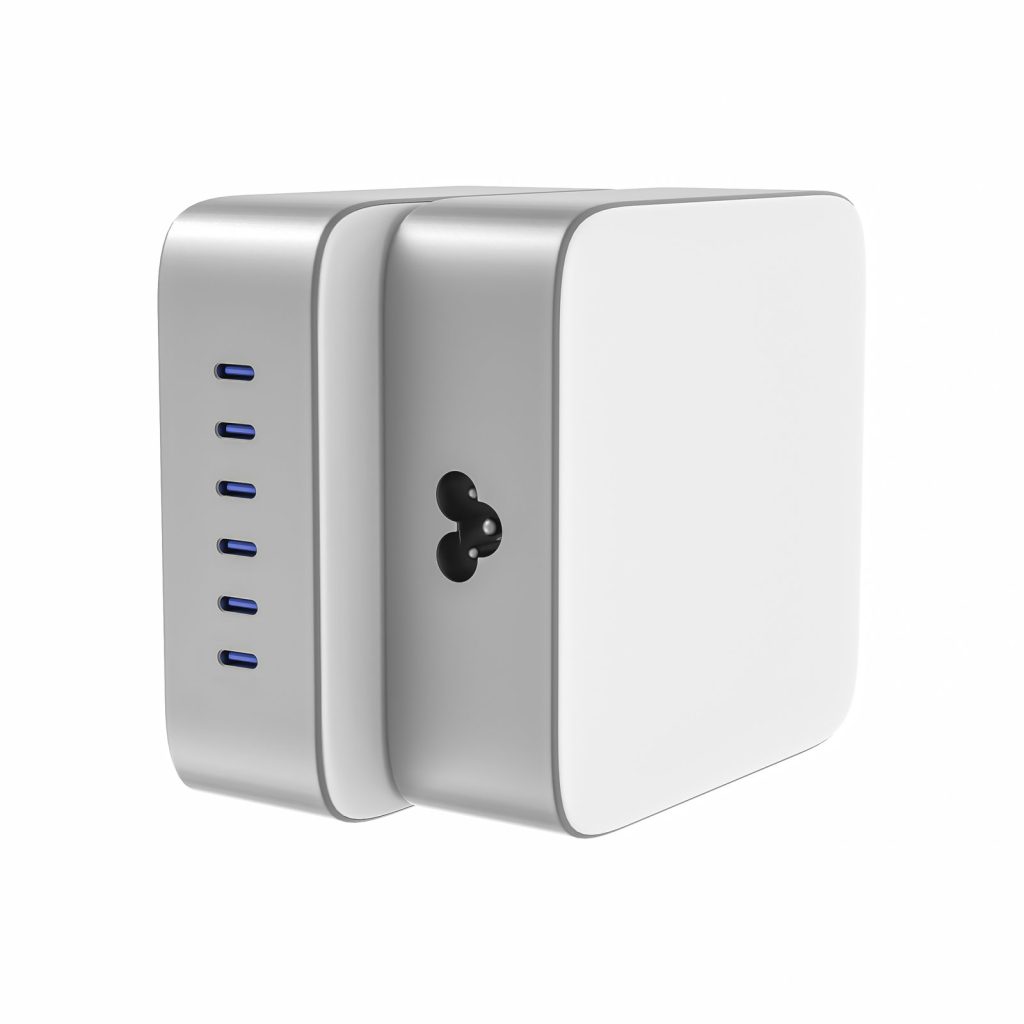
Multiport hubs rise as several devices share the desk
Desktop power used to be built around one phone, and a single-port fast charger was enough. Today most office and content-creation users carry a phone, a tablet, wireless earbuds, a watch and a lightweight laptop, so the desk has to charge three to five devices at the same time. One multiport desktop charger replaces a strip of individual plugs, freeing wall outlets and reducing cable clutter, which is the direct reason multiport models are gaining ground. Demand is no longer only about charging speed; port count, footprint and a tidy desktop all matter.
GaN raises power density so the body can shrink
GaN switches at higher frequency with lower conduction loss, allowing smaller transformers and cooling at the same power level. Industry figures put GaN penetration in consumer fast chargers at roughly 8% in 2022 and about 35% in 2026, on track to pass half around 2028; the global GaN fast-charging market was worth about US$4.85 billion in 2026, up roughly 18% year on year, with GaN fast-charging chip shipments expected to exceed 1.2 billion units (source: XinSPower citing IIM and Gongyan Industry Research Institute, October 2026). By power tier, the 65W single-port GaN remains the volume base, the 100W band is growing fastest, and 120W–240W multiport desktop chargers are viewed as the high-growth track.
| Power tier | Typical devices | What to check |
|---|---|---|
| 20–30W wall plug | Phone, earbuds, watch and other small portable devices | Compact body, travel single-port top-up, multi-region plugs |
| 45–70W | Tablet plus phone, two devices | Dual-port allocation, display or adaptive voltage feedback |
| 65W multiport | One desk charger for several devices, earbuds and watch together | Port layout, retractable cable to reduce clutter |
| 100–200W multiport | Laptop plus tablet and phone charged simultaneously | Combined output under all ports, cooling structure |
What matters on multiport models: allocation, protocols and heat
When several ports are occupied at once, power is not the sum of each port at full load; the power management chip redistributes it dynamically. When a laptop is plugged in, it is given the high-power port first, while small devices drop back to a low-power band. Buyers should separate single-port peak from the combined output when all ports are in use, so a headline maximum wattage does not hide the real performance after split. Thermal control comes next: a device left on the desk long term, case temperature rise and the cooling method directly shape the experience. Protocol coverage is the third point. USB-PD is now mainstream, while some proprietary fast-charge protocols, AVS adaptive voltage regulation and on-screen power readout affect cross-brand charging behavior.
Supply support and procurement judgment
On the supply side, desktop power can be split into portable wall plug, mid-range dual-port, desktop multiport and high-power charging station. Portable cases prioritize size and plug standard; mid-range cases check dual-port allocation and power feedback; desktop multiport cases look at port layout and cable management; high-power tiers must verify combined output and cooling structure. In this charger and desktop adapter space, SEEPOW covers the range from 20–30W wall PD/GaN to 100–200W high-power multiport: the Mini Wall PD / GaN Charger (20W–30W) serves small portable devices, the GaN Charger with AVS / TFT Display (45W–70W) and GaN Charger with Retractable Cable / Multi-port (65W) cover desktop dual-port and multi-device scenarios, the High-power Multi-port GaN Charger (100W–200W) handles laptops and peripherals together, and the Power Adapter (5V–48V, 12W–100W) supplies DC power for small appliances, routers, monitors and light industrial equipment.
The real shift behind multiport growth is that desktop power has become a small supply hub rather than a spare accessory. What separates the experience is not the highest single-port wattage, but whether multiport allocation is smooth, temperature rise stays controlled, and protocols work across brands. Start from the actual device list and each device's power, then derive port count and combined wattage, leaving enough thermal and safety margin for long-term placement. There is no need to chase the highest tier; matching the real device mix matters more.
Comments
No comments yet. Be the first to comment.