
AI Clusters Reach the Network Layer: DPU Offload and Gateways
The strength of an AI cluster no longer depends only on how many GPUs are stacked, but on whether the network lets tens of thousands of chips work together efficiently. When data cannot move between nodes, compute sits idle. Along this network path, DPUs carry hardware-level offload, security gateways adjust policy with the traffic, and domestic processor platforms cover different deployment scenarios; this layer is becoming a key base of compute infrastructure.
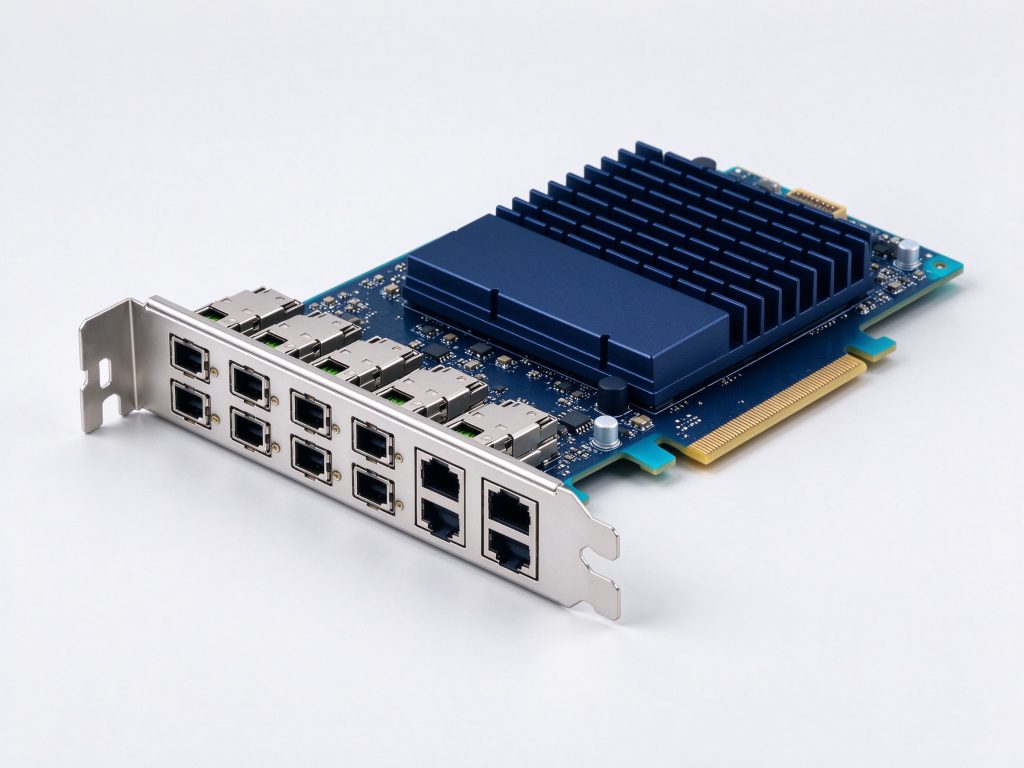
Network bottleneck: offload it off the CPU
In traditional architectures, network send and receive, protocol processing and part of storage tasks consume CPU resources; the higher the compute, the more obvious the network-side overhead. A DPU (data processing unit) hands network offload, data scheduling and storage acceleration to dedicated hardware, using high-speed interfaces to ease the network bottleneck in AI training and inference. Industry reports list general-purpose compute centers, intelligent compute clusters and 5G edge computing as the main scenarios where DPUs are gradually penetrating. Its value is not just adding a network card, but freeing the main processor to run business compute.
Security follows the traffic: gateways and policy upgrade together
As traffic scale and form change, fixed-rule firewalls find it harder to spot variants and unknown threats. Security technical specifications for AI traffic have landed, moving the industry from concept products to standards-driven development; edge security nodes are also evolving toward agentless or lightweight-agent architectures, emphasizing programmability, orchestration and observability. Security is no longer a single fixed gate at the data-center door, but a continuous capability distributed across clusters, gateways and access nodes.
| Dimension | CPU general forwarding | DPU hardware offload |
|---|---|---|
| Resource use | Main CPU handles protocol and traffic, crowding business compute | Dedicated hardware offloads; main CPU focuses on business |
| Latency | Software protocol stack, volatile under high concurrency | Hardware pipeline, more stable forwarding latency |
| Scaling | Limited by main processor specs | Adds accelerators and NICs with cluster scale |
| Fit | Small-scale, general network scenarios | Intelligent clusters, high-throughput and low-latency scenarios |
Platform selection: multiple routes from data center to edge
The platforms carrying these network and security capabilities are not a single route. At server level there are Kunpeng, Hygon, Phytium, Loongson/Zhaoxin as well as Intel and ARM processor options; field-nearby access and edge scenarios need wide-temperature, highly reliable edge gateways. Selection should separate centralized data-center deployment from dispersed on-site access, then map that to processor platform, accelerator card and gateway form factor.
The listed XINGHAN (network and security hardware), together with the network expansion modules and accelerator cards (DPU / NIC / QAT), edge access gateway platform series and Hygon processor network security platform series, supports early comparison for cluster network and security deployment.
Procurement judgment: size the network first, then offload and platform
For solution and procurement teams, estimate cluster scale, east-west traffic and latency requirements first, then decide how much network offload and acceleration is needed, rather than buying generic equipment and piling on plug-ins later. When evaluating suppliers, look at their adaptation track record in network acceleration, security gateways and domestic platforms, along with ecosystem compatibility and long-term supply. Whether the network layer can keep up with compute expansion often affects real output more than single-point hardware parameters.
Comments
No comments yet. Be the first to comment.