
Robot Tactile Sensors and Joint Modules Move from Sampling to Designated Volume
Much discussion of this round of humanoid and service robot expansion centers on whole-machine lines, but the real supply-chain maturity signal is moving to key components. Parts that used to stay in sampling—tactile sensors, joint power modules and environmental perception devices—have recently moved into designation and batch shipment. For integrators and procurement, whether a project lands steadily increasingly depends on component consistency, reliability and supply, rather than how smoothly a prototype demos.
Tactile sensors move to automotive-grade lines
Dexterous manipulation presupposes that a machine can feel and sense accurately, making multi-axis tactile sensors a watched link in the humanoid and dexterous-hand chain. Shenzhen-based Yuanxian Xianda disclosed that its automotive-grade multi-axis tactile line went into operation in August, moving past small-batch sampling into designation and batch shipment with established dexterous-hand and humanoid makers and data-collection customers. In early November it closed a new round, with financial investors alongside automotive Tier 1, LiDAR and ADAS-sensor industry partners.
The difficulty is not only making a sensing unit, but array consistency, durability, interference rejection and coordination with body control. An automotive-grade line brings these metrics under stable batch control rather than hand-tuning samples. Between a line opening and broad machine deployment, scene validation and iteration remain, paced by how much a task relies on tactile feedback.
Joint modules and perception scale up in parallel
Beyond touch, drive and perception are releasing batch signals. Hesai delivered 23,405 robot power modules in Q3, up about 96.8% QoQ, with monthly capacity around 10,000 and cumulative shipments above 35,000; full-body joint modules entered production. Its tactile dexterous hand Wave (W01), built on the modules, has 22 active degrees of freedom and joined the NVIDIA Isaac GR00T reference platform. RoboSense reported Q3 revenue of about RMB 670 million, up about 65% YoY; LiDARs on its self-developed SPAD-SoC "Peacock" chip ship in consumer robots from leading customers, and its solid-state LiDAR reached production use in robot scenarios.
These moves show the chain shifting from "can a prototype be built" to "can consistent parts be delivered in volume." If modules, tactile units and LiDARs are unstable in consistency, lifespan or interface fit, line beat and after-sales cost both get amplified.
What component procurement and integration weigh
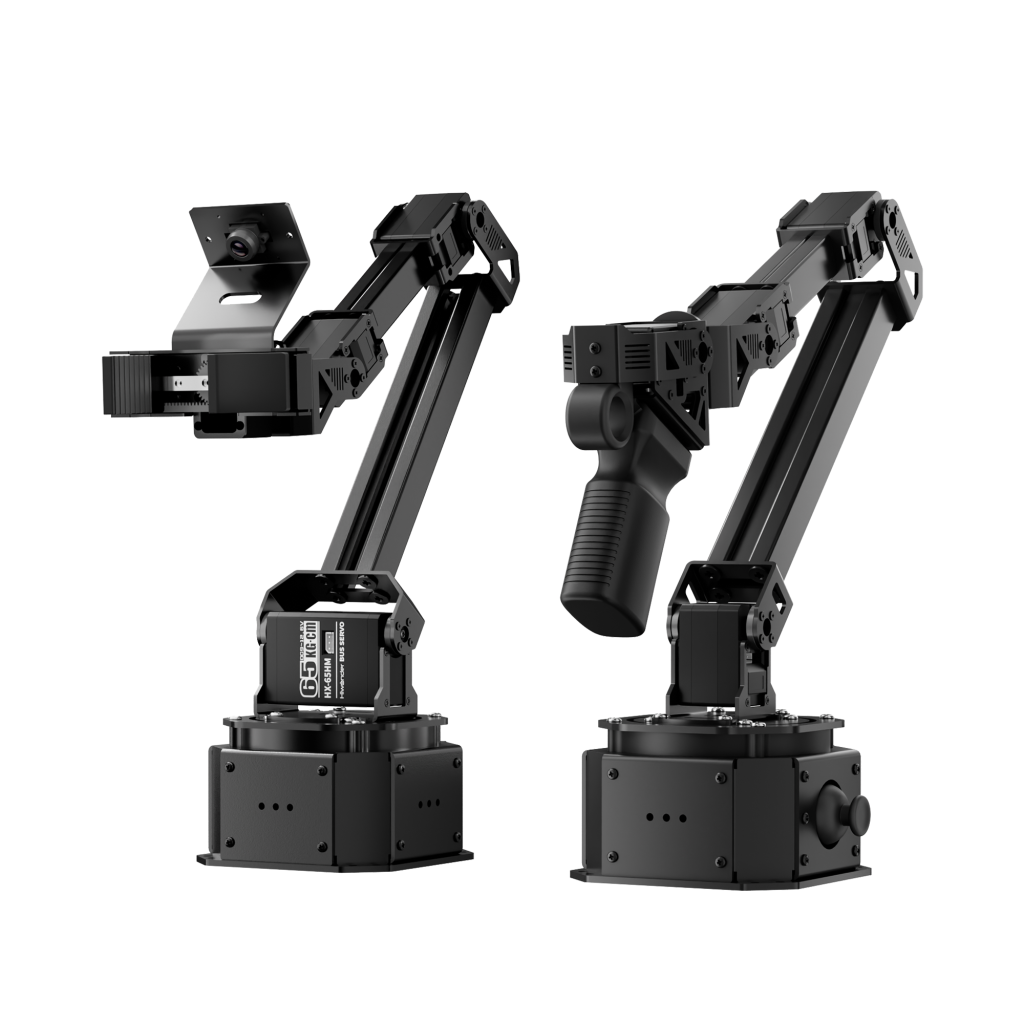
At the body and integration level, navigation chassis, arms and teaching platforms are common validation and data-collection carriers. For integrators, a Robot Navigation Chassis & Integrated Solution offers a secondary-developable chassis and ecosystem; the G605-A Six-axis Teaching Robot Workstation integrates arm, vision module and palletizing, trajectory and grinding stations into teaching; the Hiwonder NexArm Six-Axis Imitation Learning Arm suits embodied-AI courses, desktop grasping, teleoperation and data collection; the Desktop Arm & Retail Robot Terminal (Latte-art / Kiosk) targets light industrial work and smart-retail machines such as latte art and drink printing.
Sampling and validation stage
- Focus on feasibility, meeting specs and single-point demo performance
- Small batches, higher share of tuning and manual intervention
- Suited to early prototypes, comparison and concept validation
Designated batch stage
- Focus on batch consistency, durability, capacity and after-sales response
- Require standardized interfaces, maintainable firmware, traceable quality
- Aligned to line beat, batch assembly and long-run operating cost
Judgments for procurement and solution teams
Prototype specs alone are not enough. In the batch stage, check whether the supplier has a stable line and batch control, whether key metrics are repeatable, whether interfaces, firmware and algorithm integration run smoothly, and whether spares and support keep up. Integrators reduce risk by validating and collecting data on teaching platforms, desktop arms or chassis before scaling to batch machines. Machine-volume production does not mean the industry is mature: data, model, body and application hurdles remain, and component volume signals improving supply readiness rather than finished-machine scale delivery. Assess capacity commitments, validation cycles and scene fit separately; a reference-platform join or designation should not be read as proof the whole machine is ready at scale.
Comments
No comments yet. Be the first to comment.