
Cockpit Multi-Screen Drives Touch and Bar-Type Display Module Specs
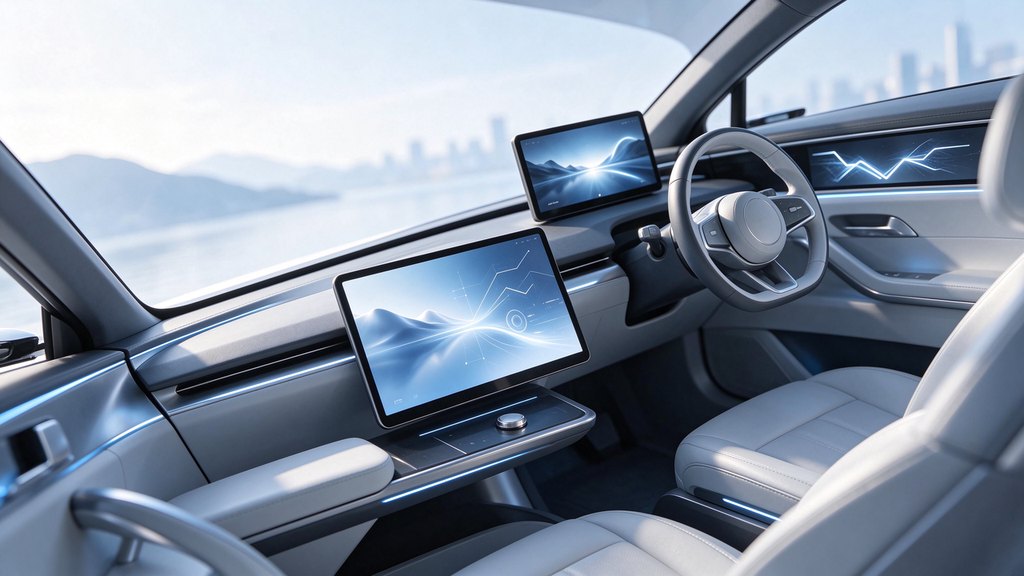
Smart-cockpit displays are moving from "one large center screen" to a multi-screen layout: center stack, passenger entertainment, instrument cluster, HUD and bar-type displays each hold a position, with screen size, count and integration all moving up. For display-module suppliers, this ramp-up is not just swapping a consumer panel into a vehicle-grade housing; touch integration, wide-temperature reliability, elongated irregular form factors and coordination with the cockpit domain controller are all issues that must be checked separately during module selection.
Large screens and multi-screen layouts advance together
According to a Gasgoo review of cockpit configurations in October 2026, screens above 15 inches already account for 43% of center stacks and are heading toward 50%; passenger entertainment screens and front-row multi-screen layouts keep rising, with rear-seat entertainment fitted on about 739,000 vehicles in the first eight months, a 6.5% fitment rate that nearly doubled year on year. High-spec Mini LED and OLED panels are entering vehicles steadily and starting to reach models below 200,000 RMB, while cockpit domain-controller penetration has passed 50%. On the regional side, Omdia data shows Chinese panel makers are expected to hold 65.2% of global automotive display shipments in H2 2026, up from 59% in H1; mainland China's share rose from 28.1% in 2019 to 56.6% in 2025 (China Youth Network, October 30, 2026).
Different positions demand different module specs
No single screen covers every cockpit position. Mordor Intelligence's November 2026 industry statistics put center-stack/infotainment screens at roughly 40% of the smart-vehicle display market; LCD/TFT holds about two-thirds of automotive displays, while OLED and HUD are the faster-growing directions; the 5–10 inch range accounts for over half, meaning clusters, controllers and small information displays remain the base. In form factor, concept cars at Display Week 2026 showed a 57-inch pillar-to-pillar OLED and a 32-inch OLED that slides into the roof (SID Information Display, July 2026); elongated, irregular and sliding screens are moving from concept into engineering validation.
Module support: touch integration and customized form factors
Automotive display modules must meet vehicle environments for temperature, vibration and service life, while packing touch, driver interface and structural dimensions into one solution. Standard TFT-LCD modules 4.3"–15.6" suit general positions such as center stack, cluster and commercial displays; Incell touch display modules 5.0"–13.36" integrate touch with the panel to reduce lamination layers and assembly steps; the 10.25" bar-type Incell display targets elongated layouts for clusters and mirrors. For clusters, wearables and small industrial positions, small-size TFT-LCD transmissive displays can be selected by interface and brightness requirements.
| Position | Common form | Module checks |
|---|---|---|
| Center stack | Large touch-driven screen, moving above 15 inches | Touch response, brightness and viewing angle, driver interface matching the domain controller |
| Instrument cluster | Bar-type or landscape, high information density | Wide-temperature reliability, low power, readability at idle |
| Passenger/rear entertainment | Independent display; multi-screen layouts growing | Zone control, audio/video interfaces and mounting fixation |
| Small cluster/controller screen | 5–10 inches and below | Interface type, package size and vehicle-grade environmental fit |
What this means for procurement and solution teams
Automotive display selection should be split by position rather than covered by one large-screen scheme. The center stack focuses on touch and visibility, the cluster on wide temperature and readability, entertainment screens on zoning and audio/video interfaces, and small positions on interface and package. Module proposals should enter at the vehicle E/E architecture definition stage, locking screen size, touch method and interface reservations early; swapping a screen type after the prototype stage often pulls in structure, harness and software changes.
Comments
No comments yet. Be the first to comment.