
Commercial Service Robots Roll Out: Kitchen, Indoor and Outdoor Delivery Split by Scene
The robots moving fastest into real operations are not the humanoid machines on stage, but commercial service robots working in restaurant kitchens, hotel corridors and campus roads. They split by operating space: the kitchen handles cooking and prep, indoor delivery moves trays and goods between rooms, and outdoor delivery closes the last mile. Terrain, navigation and shift logic differ across these segments, and separating the scenes matters more for procurement than the broad claim of “robots replacing labor.”
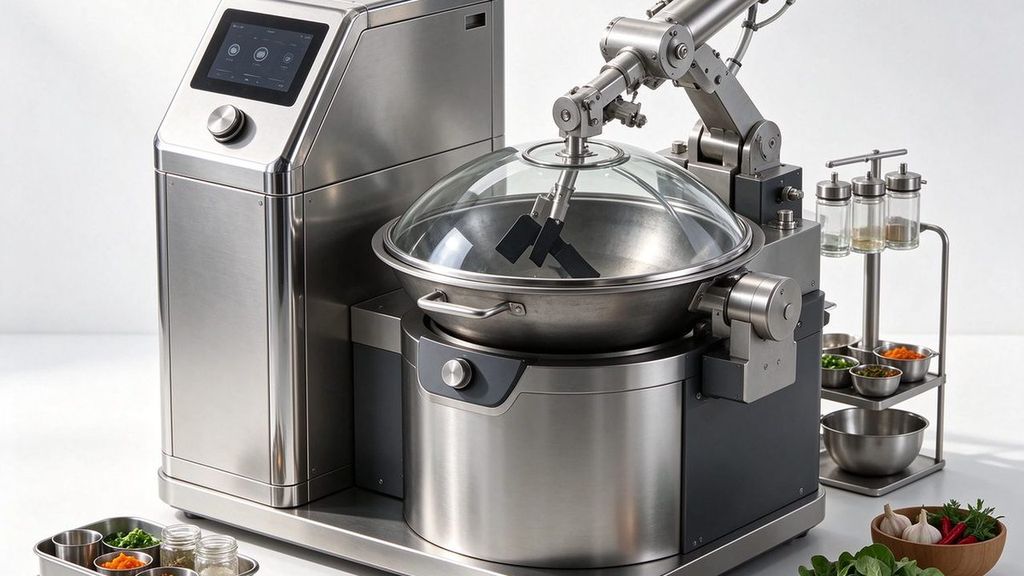
Service robots gain ground first where structure is simpler
Automation in food service is driven by labor fluctuation, output consistency and peak-hour staffing. Statistics MRC puts the global food-service robot market at about US$2.8 billion in 2026, rising to roughly US$10.9 billion by 2034, with delivery and serving robots the largest segment. On the domestic side, the 2026 China Cooking Robot Industry Report estimates the cooking-robot market at about RMB 3.7 billion in 2025 and about RMB 4.59 billion in 2026; CCTV reported in October that cooking-robot sales more than doubled year on year in the first three quarters of 2026, with scale effects also pulling device prices down year by year. These figures are preliminary agency and channel estimates with differing samples, so the more reliable read is whether the operation’s own scene actually runs smoothly.
| Segment | Typical Space | Navigation & Mobility | Core Requirement |
|---|---|---|---|
| Kitchen cooking | Stall and workstation in the kitchen | Fixed station, robotic arm and dosing unit | Consistent output, temperature control and repeatable seasoning |
| Indoor delivery | Hotels, restaurants, offices, hospitals | Vision or LiDAR SLAM, indoor obstacle avoidance | Cargo volume, multi-robot dispatch and smooth passage |
| Outdoor delivery | Campus, community, surrounding commercial areas | Multi-line perception, outdoor path planning and power-train | Rough-terrain passability, battery life and remote monitoring |
Capabilities do not transfer across the three segments
The hardware requirements are not interchangeable. A kitchen unit is closer to a standardized cooking workstation, focused on metered dosing, stirring motion and temperature curves; an indoor unit is judged on cabin volume, navigation, obstacle avoidance and multi-robot coordination; an outdoor unit must add battery management, motor and electronic control, and open-road perception. Comparing these categories in one price list easily leads to holding a delivery vehicle to kitchen precision, or pricing an outdoor job against an indoor unit.
How the supply side maps to these scenes
On the equipment side, EncoSmart lines up its range across the three segments. In the kitchen, the C1 Chinese Cooking Robot handles milligram-level seasoning dosing, timed main-ingredient release and planetary stirring to mimic wok tossing, with multi-point iron-wok temperature sensing and a temperature-curve algorithm; the LAVA Automatic Frying Robot Station serves Western fast food, fried-chicken outlets and mobile carts, running autonomous frying to peak-hour pace and connecting to order records. For indoor delivery, the D2 Flying-Saucer Indoor Delivery Robot uses vision-led multi-sensor fusion navigation for room and building delivery; the S2 Candy Box Multi-Cabin Delivery Robot carries split compartments for batch delivery and multi-robot formation; the S1D Baobao Serving Robot uses stacked shelves and obstacle-avoidance, foot-protection design for continuous restaurant and canteen service. Outdoors, the E1 Outdoor Delivery Robot combines multi-line depth perception with a self-developed power-train for last-mile delivery across campuses, communities and commercial districts.
Kitchen and stall side
- Map the menu and peak output before choosing cabin size and dosing channels
- Weight temperature curves, cleaning and sealed design over the number of dishes shown
- Leave room to connect recipes and order systems for chain-store replication
Delivery and service side
- Set navigation method, door width and elevator fit from the site layout
- Size cargo cabin, battery and multi-robot needs to avoid over-specifying one unit
- Assess protection rating, power-train and remote O&M separately for outdoor work
Overall, the rollout of commercial service robots is driven by scene maturity rather than a single tech headline. The kitchen first solves standardized cooking, indoor delivery solves high-frequency transport, and outdoor units are still adapting to rough roads. What is worth tracking next is multi-robot dispatch efficiency, payback per unit and reuse across scenes. For buyers, working out site terrain, traffic and staffing first, then matching a machine, remains safer than chasing the latest concept.
Comments
No comments yet. Be the first to comment.